Among the matters of interest concerning the straw trade which came before a well-attended meeting of the Luton Chamber of Commerce on Friday evening was a communication received from a Belgian engineer in which he stated that he could supply a machine for the manufacture of tagals, braid etc of the same kind as is now received from Japan and Switzerland. The machine was automatic in its action so that it could produce material much cheaper than supplied from Japan.
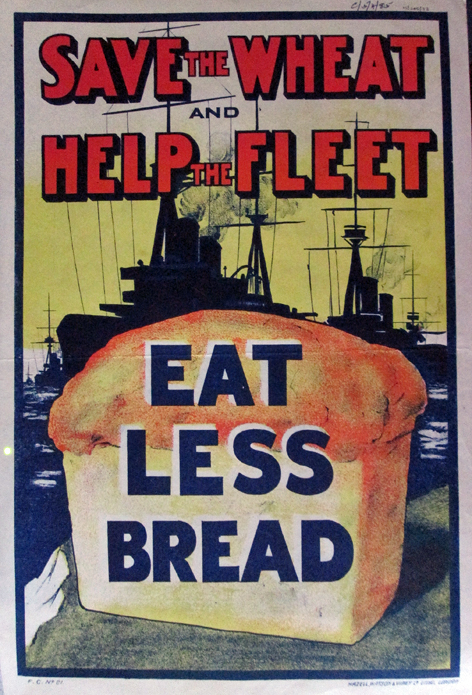
Even before the 1917 German U-boat campaign threatened Britain's food supplies with the sinking of up to 400 merchant ships a month and subsequent rationing in 1918 that led to posters like the one above, feeding the family was becoming increasingly expensive and problematic.
Stories from the Beds & Herts Saturday Telegraph: April 15th, 1916.
Lady Wernher, of Luton Hoo, supplied dramatic and profitable episodes at yesterday's Red Cross sale at Christie's in London. Hitherto a generous donor of gifts, she appeared for the first time as a buyer.
Further problems involving tribunals and the military administration arose at a sitting of the County Appeals Tribunal in Luton on April 13th, 1916.
A man whose case had been adjourned to allow him to produce a certificate of discharge as a time-expired soldier had made enquiries and applied to the Record Office. The result was that it appeared that copies of discharges, which exempted men from the provisions of the Military Service Act, were somewhat hard to get.
"Jimmy" Brandham, the well-known Luton Town footballer, formed the subject of one of a number of Markyate claims against military service which came before the Hemel Hempstead Rural District Tribunal on Wednesday.
His exemption was asked for by his employer, Mr F. Spary of Markyate, and the original claim was that he was "starred" [in a reserved occupation]. At that time the military representative contended he was not "starred," but afterwards found that he was "starred" and applied for him to be "unstarred".
The highest fine to date - £5 with 5 shillings special costs - was imposed at Luton Divisional Sessions on Monday, April 10th, 1916, in what chairman George Oakley described as "the most serious case we have had" in relation to lighting regulation offences.
Quartermaster-Sgt W. Sharpe, formerly a member of the Luton News/Telegraph staff, is now on active service in Salonica and sends an interesting description of that town - a town which is figuring so prominently in the history of the war and which gives promise of figuring even more prominently as the days advance.
Stories from The Luton News: Thursday, April 13th, 1916.
Crowds turned out in Luton on Monday for a Royal visit. Princess Victoria Louise, a granddaughter of Queen Victoria, arrived by train from London to open a new YMCA hut at Biscot Camp after being the guest of Lady Wernher at Luton Hoo.
At a special Borough Court on Tuesday, April 11th, 1916, four Luton young men were charged with not having complied with the order of the Military Authorities to enrol themselves for service on April 8th. Their names were Bernard Bonner, of 20 Park Street West; Sidney Charles Bell, of 23 Ashburnham Road; Harry Edward Stanton, of 89 Wellington Street; and Montague R. Dimmock, of 92 New Town Street.
"That in the opinion of this Council, the most effective and necessary means of saving money for the purpose of the war is for the Government to deal effectively for the period of the war with the drink traffic by limiting the imports for its manufacture and curtailing throughout the country its hours of sale."
A sequel to the December 28th, 1916, tram crash came in a three-hour hearing at Luton County Court on Thursday, August 9th, 1917, when one of the injured passengers, Miss Kate Brandon, sued tramway lessees Messrs Balfour, Beatty and Co Ltd for damages for personal injuries sustained and loss of wages.
Stories from the Beds & Herts Saturday Telegraph: April 1st, 1916.
Five Zeppelins were believed to have taken part in an air raid over the Eastern Counties last night, reportedly dropping 54 bombs. Although the "squawker" was not sounded in Luton, precautions were taken.
Pte Hugh Norwood, of the Machine Gun Company, 3rd Guards Brigade, writing to his parents (Mr and Mrs A. A. Norwood, of 'West Hill,' Ashburnham Road, Luton) stated that he has seen a few of the Tribunal cases and read the arguments of the "conscientious objectors," and expresses the opinion that they are "absolutely disgusting".
Anyway, he guesses the Army can do without them, though he adds: "It would do them good to have an active month or so out at the Front."