

Quartermaster-Sgt W. Sharpe, formerly a member of the Luton News/Telegraph staff, is now on active service in Salonica and sends an interesting description of that town - a town which is figuring so prominently in the history of the war and which gives promise of figuring even more prominently as the days advance.
He says: "One is given a very favourable impression of the town in viewing it from the decks of the vessel in the harbour. The buildings appear to be set out with spacious orderliness and the majority seem to be of a modern character, but then a disappointment awaits the visitor immediately upon disembarkation.
"At night the view of the town from the harbour is particularly charming. The lights in the factories (or perhaps I should have said mills) are closely set near the sea, but as the town recedes and the houses become more scattered the lights gradually fade in intensity, and only a glimmer can be seen here on the distant slopes of the mountains, which are almost invariably silhouetted in the brilliant moonlight of an Eastern Mediterranean night.
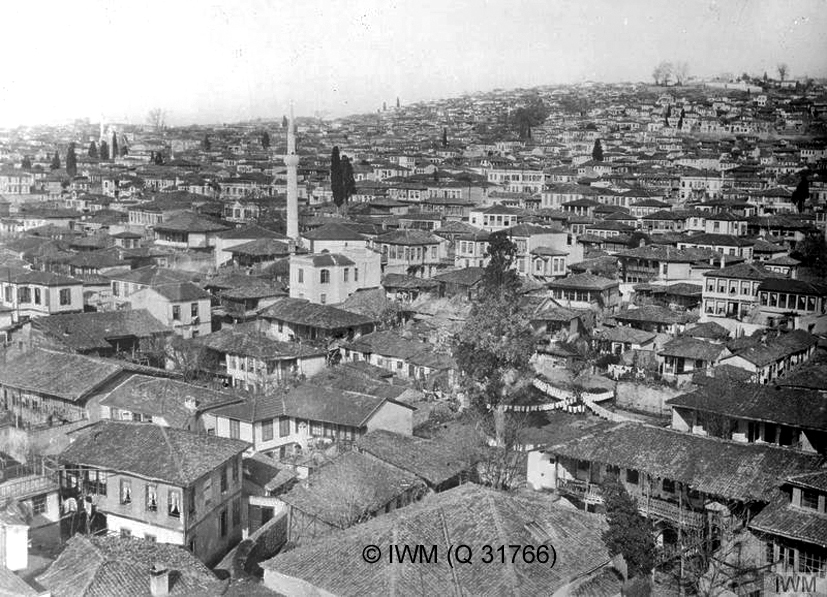 "Once on shore this favourable impression quickly vanishes. It is indeed a rude awakening! Buildings of spacious dimensions and of pleasing architecture are found only here and there - these are generally hotels, cafes or business houses. Elsewhere the buildings are typically Near East - small, closely situated and of dirty appearance.
"The streets are narrow, frightfully uneven, and only attempts are made at side-paths for pedestrians. These streets are paved with granite which I understand come from the hills and mountains in the immediate vicinity of the town. Running practically from one end of the town to the other is the principal street, which continues almost parallel with the sea.
"A few minutes walk from the docks, towards the eastern side of the town, one comes across numerous landing-stages. Here all the vessels trading between the town and the islands in the Grecian Archipelago load and discharge their cargoes. These vessels, which are principally of the sailing type, carry as a rule fruit.
"Working here every day is a curious collection of labourers whose nationality would be hard to determine and who work with that noise and proclivity to quarrel upon the slightest provocation, characteristic of the lower classes of the Eastern Mediterranean.
Leaving the main street on the right one soon strikes that part of the town in which are found the bazaars and markets. It is here that one fully realises the cosmopolitan nature of the town. There are to be found here representatives of almost every nationality in the world - certainly of Europe. The shops are small and generally of the 'lock-up' type, and the articles are displayed with little, if any, attempt at order.
"The proprietors stand at the doors enticing would-be purchasers. One continually hears the cry, 'Come on, Johnny, come and buy'. It is uttered by Greek, by Turk, by Albanian, by Jew, by Montenegrin; in fact by all. Everyone wearing the British uniform in Salonica is a 'Johnny' and the tradesmen use their phrase with parrot-like repetition.
"Despite their obsequious manner, these people are very astute traders, and the British Tommy usually pays through the nose for any article. Whilst if is only fair to mention that there are existent certain circumstances (of which I may not write) which have resulted in a rise in price of commodities, one cannot help coming to the conclusion that the propensity of the Greeks and others here to charge heavily for all articles is due to their avaricious nature.
"Another point! Britain is regarded as extremely wealthy, and to these people anyone coming from there must also be rich. I have been in conversation with several Greeks of good standing here, and they assure me that prior to the war spreading to the Balkans, Salonica was one of the cheapest towns to live in in the Mediterranean. They agree that it is now certainly one of the dearest.
The Turkish element is very prominent here, and their schools are to be found in various parts of the town. Only the other day I spent an interesting half-hour watching a number of young Turks at their lessons in the open air. They were, so far as I could judge, engaged in committing to memory certain passages of the Koran. The children of the true followers of the Islamic faith are compelled to learn the greater portion, not the whole of the Koran. No matter how illiterate a Mohammedan may be, he knows his Koran and is able to recite passage after passage from his holy book.
"The residential quarter of the town is on the eastern side. Here the majority of the houses are well set out, of a commodious character and of elaborate architecture. In this quarter are to be found the Consulates - the German, Austrian and Turkish Consulates are now sealed and under British guards. The most interesting of all the Consulates is the Serbian. Day after day there is a constant stream os aged men and women, and little children who have lost their all in the terrible war, all seeking the assistance of the Consul. It is a very pathetic sight.
"Many of the more active refugees are now finding profitable employment in various capacities with the British and French forces, and the stress of their position is consequently materially relieved.
"Although, as I have mentioned, the majority of the houses in this part of the town are very fine structurally, beyond the main street through which the trams run there is no attempt at a well-organised street system. In fact the side streets principally consist of what we in England would call pathways - merely unprepared broad passages with no metalled surface and no pedestrian pathways, as we understand them.
"Away towards the foot of the hills the houses become scattered and of a poorer class, occupied by people apparently following agricultural pursuits. On the outskirts of the town one continually comes across deep ditches which were no doubt constructed by the military in the earlier Balkan wars. In fact, traces of these wars are frequently seen. The walls of one of the Greek hospitals on the northern side of the town are profusely marked by shrapnel. These were caused in the recent Bulgarian War.
"And again, there are evidences of the present war - ruined factories and houses destroyed as a result of the last Zeppelin raid. These air raids have now practically ceased, but, of course, one cannot speak with an y certainty concerning the future. The French have scored highly in the matter of combatting the raiders. The other day they succeeded in bringing down an enemy aeroplane just outside the town. It was, needless to say, a German machine, and painted on the wings were huge Iron Crosses. This machine was placed on exhibition for several days in some public gardens in the centre of the town. It was an object of great interest.
"Behind the town, as I have already mentioned, are wild, desolate mountains over which huge flocks of carrion crows fly continually and upon which packs of wild dogs roam - seeking what they may devour. The temerity of these birds and dogs is alarming.
"In a tour among these mountains one realises the enormous difficulties of campaigning in such a country. The town is naturally fortified and this, together with the artificial fortifications - well no wonder the Allies style it impregnable.
"Somewhere here are the British and French Tommies, happy (although, of course, always thinking of those at home), amid the most barren and desolate of spots. At present things are very quiet, and I can give no stirring tales of derring-do. Of the future, however, we must hope."
[Beds & Herts Saturday Telegraph: April 15th, 1916]