Luton Town Council on January 7, 1919, resumed consideration of the Housing and Town Planning Committee's recommendation to agree to the erection of 1,000 new houses under the Government's scheme for providing financial assistance, a debate that had been adjourned a month earlier due to lack of information.
It was pointed out that the adoption of the report did not commit the Council to any definite scheme of building, and critics with one accord agreed to accept the principle laid down, and in the end the recommendation was unanimously supported.
Delays in the process of demobilisation are causing an outcry in all parts of the country, wrote The Luton Reporter on Tuesday, January 7th, 1919. However, Mr H. G. Bovey, manager of Luton Employment Exchange, said no pains and time were being spared locally to expedite the efficient handling of an admittedly difficult problem.
Taking first the munition workers, Mr Bovey said there were in all something like 6,000 men, women, boys and girls to be demobilised in the Luton area, extending as far as Welwyn in one direction and Dunstable and Leighton Buzzard in another.
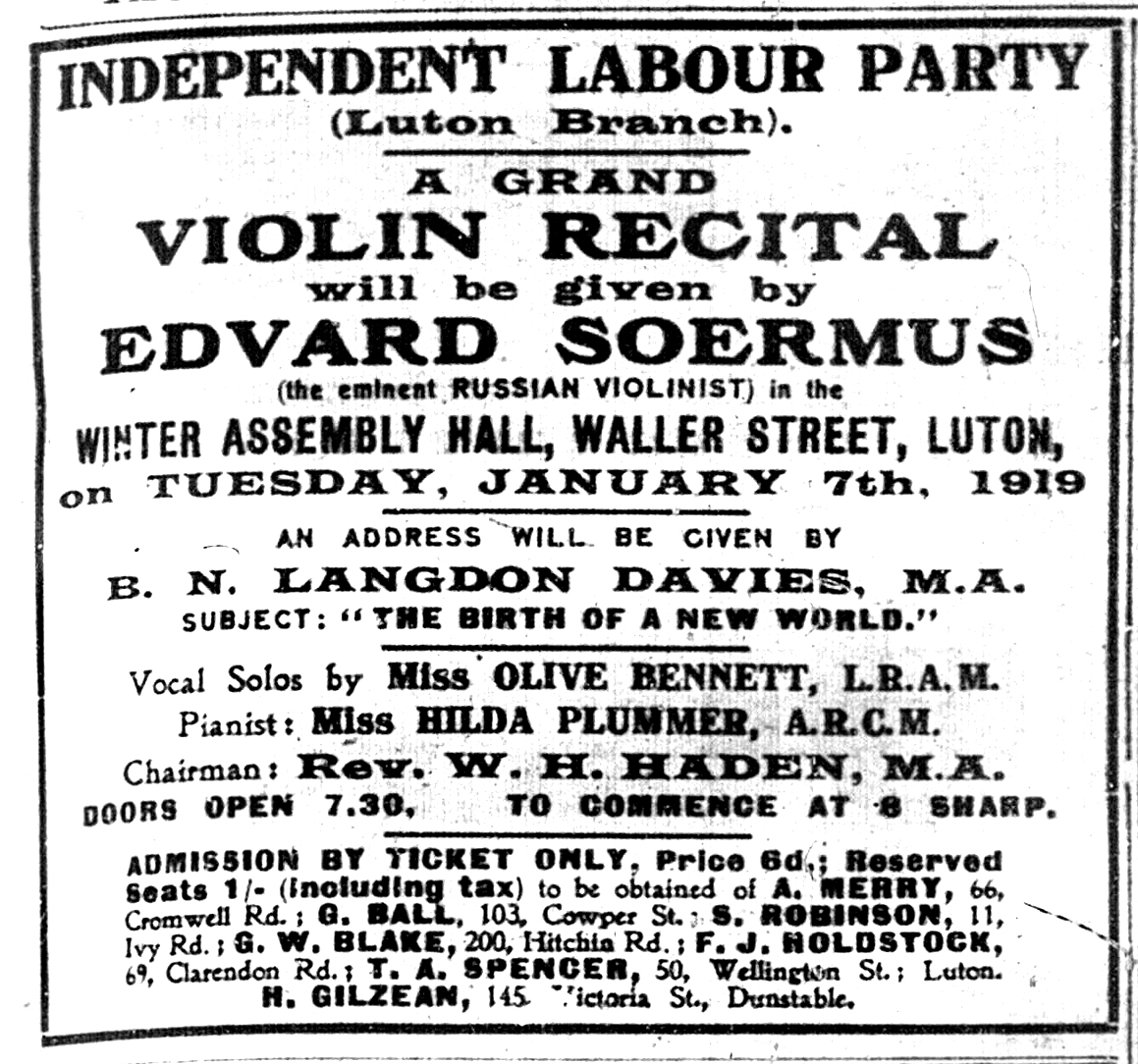
A remarkable gathering was that on Tuesday [January 7th, 1919] at the Winter Assembly Hall, Waller Street, when the Luton branch of the Independent Labour Party held a rally. The programme consisted of music and speeches, and both elements were of a very unusual character.
Pte Sidney Charles Perry, 27909, 1st Northants Regiment, had been captured as a prisoner of war at Nieuport in Flanders, but on December 19th was able to travel via Switzerland to get back home at 15a St Saviour's Crescent, Luton, on January 5th, 1919.
In the Tuesday Telegraph of January 14th, he told of some of the experiences he had undergone as a prisoner of the Germans, recalling that for eight weeks things had been very bad.
In its first edition of 1919, a political correspondent of the Beds & Herts Saturday Telegraph looked back over the past year.
1918 has not seen the formal establishment of peace, he wrote, but it will always be remembered as the year in which the Great War came to an end. For four years the chronicler has had to say, with as much fortitude as he could summon, 'the end is not in sight'.
Among the unpleasant duties which fell to the lot of Pte Horace William Kilby, 21468, 9th Battalion East Surrey Regiment, of 11 Salisbury Road, Luton, during the time of his captivity as a prisoner of war in Germany was the burying of the dead bodies of those of his comrades who had succumbed to illness etc. He tells us that on his last birthday on June 4, he interred no fewer than 48. This was in the course of a seven months' stay at a hospital, suffering from dysentery, the disease from which so many of his comrades died.
As Luton and Britain as a whole began to look at picking up the pieces of a peacetime economy after four years of war, Board of Guardians member Violet Lewis presented her thoughts on town planning in an article published in the N-T-F & Tuesday Telegraph on December 31st, 1918, as follows:
Censorship was tight during the Great War and it was not until after hostilities had ceased that full stories could be told. For instance, although Luton had come through unscathed from Zeppelin raids, townsfolk had witnessed a blazing airship or two that targeted the London area.
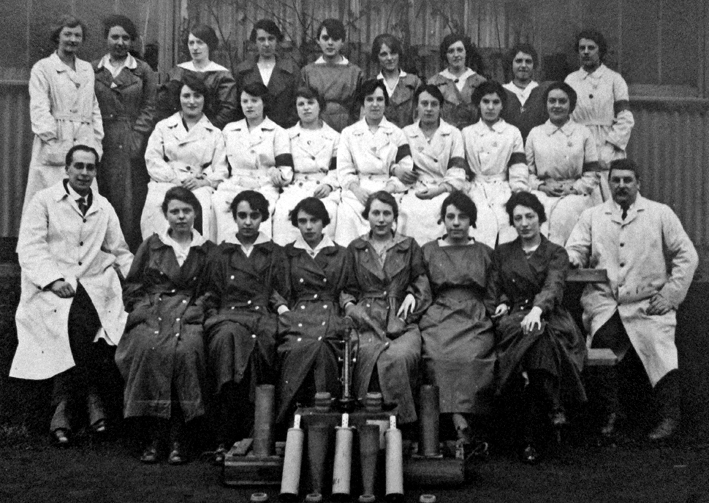
A tribute to the munitionettes involved in the production of weapons of war was written by J. W. Binstead and published in the N-T-F & Tuesday Telegraph of December 31st, 1918. It read:
Pte Charles Odell, 6676, 3rd Battalion Bedfordshire Regiment, of 26 Langley Place, Luton, arrived home on leave for two months from Saturday, December 28, 1918, after being a prisoner of war in Germany since November 1914.
The Luton News of January 2, 1919, told the distressing story of how a soldier was killed an four children injured by an unexploded bomb lost during earlier tests at Ivinghoe Beacon.
The Christmas festival, said the report, was tragically marred for a family at Ivinghoe by the sudden explosion of a bomb found in a field, causing the death of a soldier and seriously injuring four children.
Just days before Christmas 1918, Lieut John Crawford Cunningham, of 35 Cardiff Road, Luton, arrived home after spending some months in Germany as a prisoner of war and being involved in a World War One equivalent of the Great Escape of WW2.
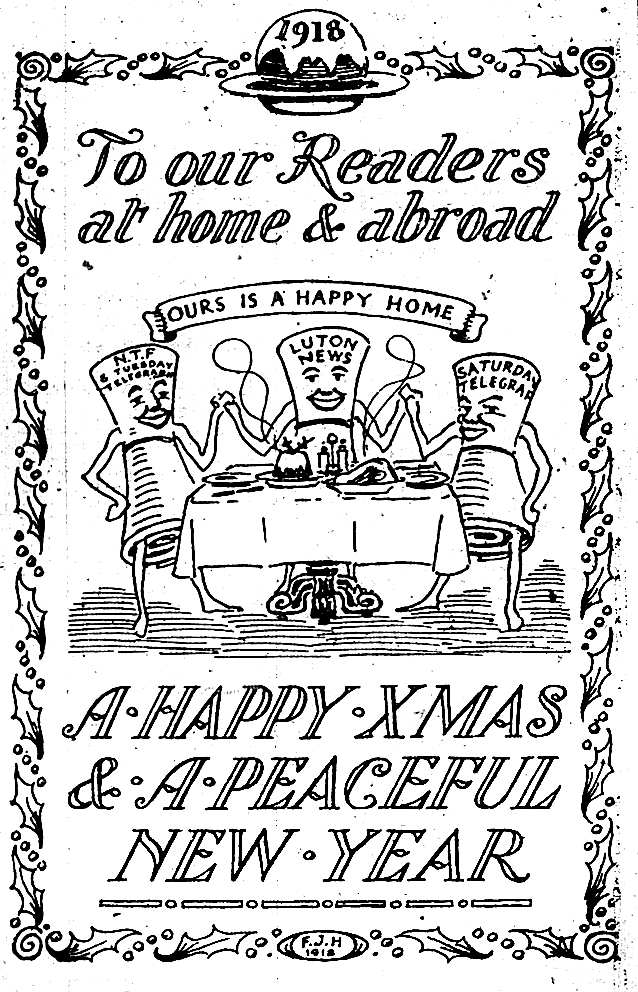
While the Luton News and its sister newspapers were wishing readers a happy and peaceful Christmas 1918, shoppers were having difficulty getting in the Christmas spirit.