

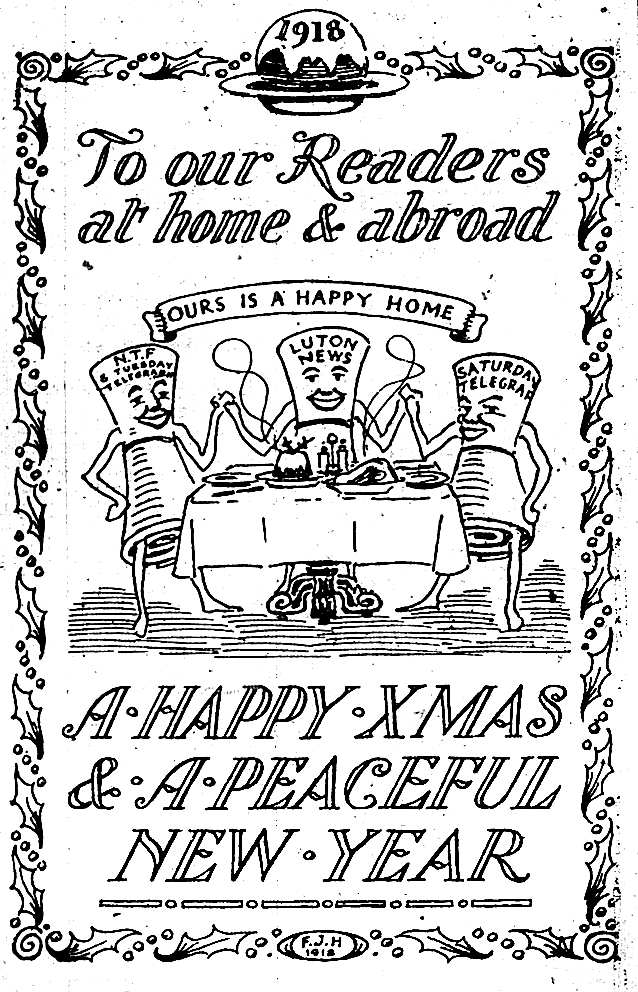
While the Luton News and its sister newspapers were wishing readers a happy and peaceful Christmas 1918, shoppers were having difficulty getting in the Christmas spirit.
The Luton News reported that the scarcity of wines and spirits had entailed queues of varying length from time to time, and queues in the days just before Christmas had formed at shops 30 minutes before opening time. In one instance, a shop in George Street had had a queue of 100 people, and “the eagerness for spirit, in fact, required the curbing influence of a policeman”.
And making a penultimate trip round the shops for his night of nights, even Santa Claus got a few shocks. He found in toyland that scarcity had made work with the price tickets, and whereas he was able in his preliminary shopping to purchase innumerable things at more or less reasonable prices, almost everything had enhanced in value.
Thus he could buy whistles a fortnight ago for 1d each. On Saturday night the price was 1½d. If he wanted a trumpet, the tune of the vendor was 3½d, compared with 2d previously; and the timber gee-gee, like the mortal type, had risen in the estimation of the dealer according to his scarcity. He went up from between 6d and one shilling to 1s 6d to 1s 11½d.
Picture books might have been the exclusive work of Royal Academicians, and many of the story books might have been Robert Louis Stevenson's first editions, for they had increased by 50 per cent.
In the fruit market prices had likewise advanced. Oranges sold by the lb are ever so much better than the common 'three a penny' of pre-war days. Five small jaundice-suffering examples weighed 1lb and not less than 8d purchased them.
Apples – well, one required a ready reckoner and a mathematical key to solve the prices, while nuts were a hard problem to crack. In one shop the price was 4s or 4s 6d, in another 3s 6d or 3s9d. They were Brazils, and as the province of that name is a rather extraordinary place, the trifling difference of 9d or 1s per lb may be accounted for. Pre-war price was 6d to 9d per lb.
Dried walnuts have a war value, for they were 4s 8d per lb, compared with 8d in 1914; the cocnut, which the itinerant Fair and Wakes man made a profit from at a penny a throw, even if you knocked down at each throw, or sold at 2d each to men not in physical training, had travelled from that figure to 1s 2d and 1s 4d, with or without whiskers.
Spain has also reaped a good harvest out of nuts if the men of Barcelona have extorted prices equivalent to those of British retailers - from 3d to 1s 9d per pint is no mean advance, and gives one an idea why anarchy is bred in Barcelona if not in Luton.
Altogether, Santa and Mrs Claus had a bad time on Saturday and last night, and we fear that many a stocking will have a considerable lining of waste paper, while those that are full of good things will be responsible for bulky pockets or swollen bank balances.
[The Luton News: published Tuesday, December 24, 1918 – dated December 26]