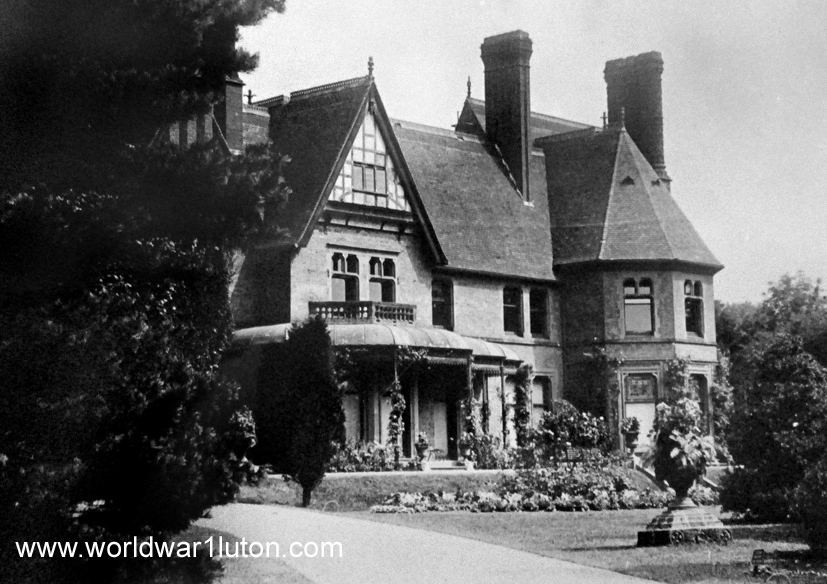
Under the above headline, the Tuesday Telegraph on February 11th, 1919, wrote that it was with pardonable pride that it referred to the subject of Wardown House. The news that day was good. The Maternity Committee was busying itself looking about for an alternative scheme – in other words, Councillor Primett and his colleagues were climbing down. The report went on:
Following a robust attack in the Tuesday Telegraph on Luton Town Council's decision to use Wardown Mansion as a maternity hospital, the Saturday Telegraph followed up four days later (September 8th, 1919) with a perhaps more bitter condemnation of the scheme and the men behind it. Said the Telegraph:
A soldier patient at Wardown V.A.D. Hospital who had seen service throughout the war and come through safely until a few weeks before the armistice, when he was wounded and lost a leg, was presented with the Military Medal, watched by an audience at the Palace Theatre in Luton.
The Beds and Herts Saturday Telegraph (February 8th, 1919) reported that he presentation provided a pleasing interlude at the Palace, when Mayor (Councillor Henry Impey) pinned the medal on Cpl Arthur Poole, 200848, 1/5th Battalion South Staffordshire Regiment.
Women are waiting in queues in Luton once again, not for food but for the means of obtaining it. As a result, some extraordinary scenes were witnessed yesterday at the Public Library and the Labour Exchange, where the subsistence allowances were paid out to discharged munition workers, reported the Beds & Herts Saturday Telegraph (February 8th, 1919).
A letter opposing a maternity home at Wardown, from a ratepayer who was one of the original supporters of the acquisition of the park and mansion for the town, added fuel to the controversial debate at the meeting of Luton Town Council on February 4th, 1919.
The letter, read at the meeting from Mr S. J. Worsley, of 3 Ivy Road, Luton, received an unsympathetic hearing from most, but the debate produced the first hints of unhappiness among some Council members to the proposal. And it came in the wake of a scathing attack on the proposal published in that day's Tuesday Telegraph.
Following a previous letter from two Lutonians serving on HMS Agamemnon about the British Fleet's entry into the Dardanelles, a second letter dated January 13, 1919, described their visit to Constantinople and Sevastopol. Signed by L. B. Briars, It read:
What is considered by many to have been one of the best bits of war work performed in Luton has come to an end under the happiest possible conditions, wrote The Luton Reporter in its February 2nd, 1919, edition.
Yet six months or so ago the Luton Borough War Prisoners Fund, which was established in June 1915 to provide necessaries and comforts for prisoners of war whose homes were in the town or immediate neighbourhood, gave cause for real concern.
Luton Town Council's unanimous decision to use Wardown Mansion as a maternity hospital for three years or longer brought a hostile response from the local Press. Ahead of the next Council meeting that evening, the Beds & Herts Tuesday Telegraph led a scathing onslaught in its February 4th, 1919, edition, warning that members of the Council were riding for a fall if they did not immediately reverse their decision.
When Lutonian Capt Bernard Arthur Smart (pictured) took part in the first ever air raid launched from a ship at sea and gained a bar to his DSO, the British Admiralty provided no details of the feat he and his fellow pilots had accomplished in destroying the German airship base at Tondern on July 19th,1918.
First hostile response to Luton Town Council's planned use of Wardown Mansion as a maternity home came in the Beds & Herts Saturday Telegraph of February 1st, 1919, under the heading 'Hands off Wardown'. It read:
“A repulsive story of German cruelty” was how The Luton News (January 23, 1919) described the story of repatriated POW Sapper William Harold Woodford, of New Cottages, Aley Green. Mrs C. R. Green, also of Aley Green, wrote that William (“or rather what is left of him”) was in England and that she and his wife Lizzie had visited him at Lewisham Military Hospital.
Sgt Sidney Adolphus Dines, 16175, 2nd Battalion Bedfordshire Regiment, was awarded the Military Medal for conspicuous gallantry during a bombing raid shortly before the signing of the armistice.
The Luton News (January 23rd, 1919) reported that Sgt Dines was a former pupil of Chapel Street School and his home address was 39 Ashton Road, Luton.