

Digest of stories from the Beds & Herts Saturday Telegraph: October 26th, 1918.
The influenza epidemic in Luton continues to spread. Although the town, in comparison with some other places, has been let down fairly lightly so far, unhappily there have been several deaths and, unfortunately, one or two of the doctors have themselves been temporarily incapacitated.
The last of the elementary schools were closed down on Thursday, hundreds of children having contracted the malady, and every factory, workshop or office in the town has more or less depleted of its occupants. Some of the most important factories have been hit extremely hard, and employers have had to take precautions in the way of disinfecting. Many machines in works have been rendered idle.
Matters were not so bad at the works of George Kent Ltd as first supposed, and yesterday afternoon Mrs Leigh Kent was able to inform our representative that not more than 100 were away. Considering the number of girls employed at the works, this is more gratifying, and is no doubt due to the splendid preventative measures which the firm immediately took.
But the disease had descended on several other establishments relentlessly, and it is essential that any person who contracts the malady should stay at home for a few days until the danger of further infection is passed.
A Saturday Telegraph representative had a lengthy chat with the Medical Officer, Dr Cox, who is making every effort to stem the tide of the outbreak. In the first place he has had printed a large number of posters and handbills which by now will probably have been placed in prominent positions in works and other places for the guidance of the public.
In the second place he has addressed urgent circulars to the clergy and ministers of the town to curtail the list of services in the churches, and if possible to eliminate the Sunday evening service during the period of the epidemic. The reason, of course is obvious, for with large numbers of people gathered together in confined spaces breathing the same atmosphere, and probably infected persons among them, the risk of a large spread of the germs is very great.
Dr Cox is also making a similar urgent appeal to the managements of the local picture theatres and other places of entertainment to close their halls completely while the epidemic is raging. The same appeal also applies to any gathering at which large numbers may assemble.
-
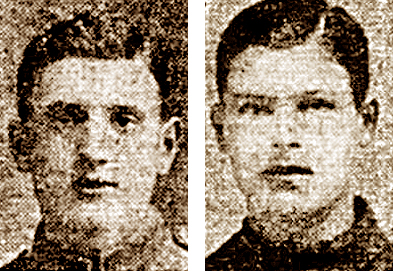
Two Luton soldiers were in line for honours. Cpl Frederick William Waller (pictured left, Shropshire Light Infantry), of 29 Kingston Road, was to receive the Military Medal for bravery as a Lewis gunner, and wounded Company Quarter-Master-Sgt Leslie S. Etherington (pictured right, 6th Royal Iniskilling Fusiliers), of 47 Wimbourne Road, was being recommended for the Distinguished Conduct Medal and a commission.
-
“Our tank went over a mine and it blew up. The effect was like a firework display with acrobats thrown in.” This is how Pte William Thomas 'Tommy' Northwood (Tank Corps) described the incident in which he was wounded, as a result of which he was admitted into hospital in France on October 1st. He is the son of Mrs Northwood, of 119 Albert Road, Luton, to whom he has written that it was wonderful how he escaped so lightly. He has been in France since 1916 and was formerly employed in the family's manufacturing business.
-
Pte J. Hall (Hussars) was wounded at Le Cateau on October 8th and is now at St George's Square Hospital. His home is at Park Corner, London, but his wife now resides in Luton. He was wounded on both legs and one shoulder at the same time that the horses were killed and the drivers on the box were wounded. In civilian life, Pte Hall worked for Messrs Gregory, Guildford Street, and he was Secretary of Albion FC.
-
A meeting for the straw and felt hat workers of the town, arranged by the local branch of the Workers' Union was held at the Corn Exchange on Wednesday evening. Mr C. W. Gibson, a London organiser, appealed to all workers to consider their position and their welfare made possible by the assistance of a trade union.
-
People last Saturday evening wondered why the Saturday Telegraph was late on the streets. It was due to the breakdown of the electricity supply. The whole of the town's current was cut off for at least half an hour. Mr Cook, the Electrical Engineer, informs us that trouble arose with one of the turbines and the set that was feeding the town was shut down. In ordinary circumstances the matter would have been remedied within a few minutes, but the electricity depot is suffering from acute shortage of labour, despite its position of national importance.
-
At nearly 11 o'clock last night a fire on the Winsdon Hill allotments resulting in the destruction of two barns and contents. The fire was not discovered until it was too late to save the barns. All the garden tools in the barns were destroyed, as well as a four-wheeled trolley.