

Digest of stories from The Luton News: Thursday, September 19th, 1918.
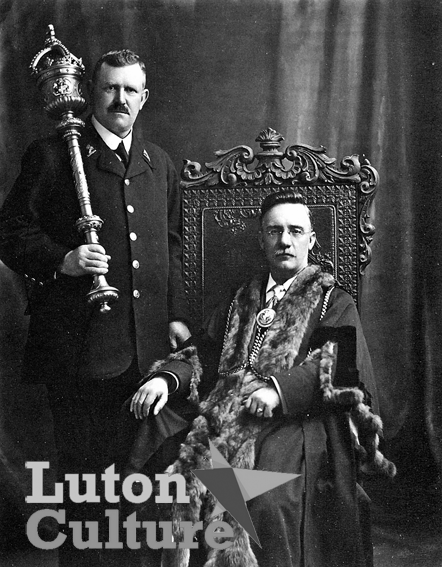
On Tuesday evening, when the Luton Town Council had dealt with all the ordinary business, the Mayor (Councillor Charles Dillingham) drew attention to the last item on the agenda: “Mayoralty – The Council are desirous to remain in committee to consider the question of the Mayoralty for 1918-19.”
Remembering the little friction there was last year because no notice of the 'To be' meeting was sent out, he added: “We have had this put on the agenda so that there may be no misunderstanding.”
The reporters having departed, member sat down in a state of expectancy for a few moments, and then Councillor Bone suggested that the Mayor should be asked if he “desired” to occupy the position for another year.
Councillors Attwood and Escott supported this suggestion, but the Town Clerk (Mr William Smith) thought it would be most humiliating for the Mayor to have to answer such a question, and suggested that the Mayor could not do anything unless he first received an invitation to continue.
Alderman Arnold took the same line, and when it was suggested that the meeting should be open for nominations, as there were two or three candidates in the field, the Mayor emphatically stated that he would not submit to his name being put into the competition.
There was a little passage when Alderman Staddon suggested that they should throw open the voting to include the lot, the Mayor remarking: Excuse me, Mr Deputy, I am in the chair.” He then asked for nominations.
Alderman Wilkinson proposed Councillor Henry Impey, and Councillor Escott proposed Councillor Arthur B. Attwood. The voting was very close indeed. The result was Impey 11, Attwood 10. There was one blank paper.
As matter now stand, therefore, Councillor Impey (pictured above) will be the Mayor for the ensuing year.
-
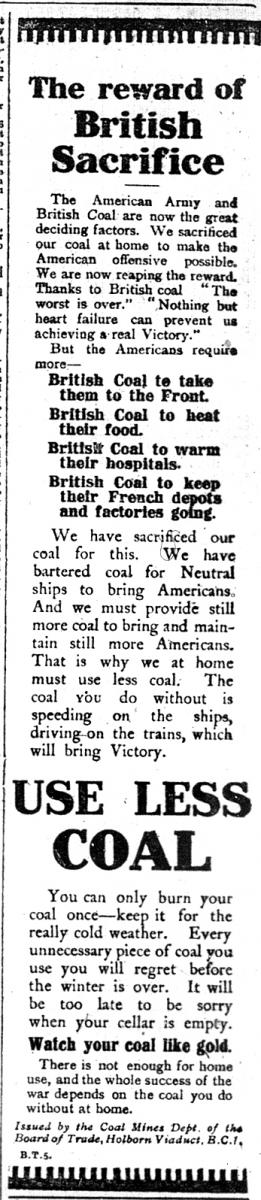 In the wake of the notice (reproduced, right) appealing for the use of less coal, The Luton News wrote in its editorial column: “In spite of every effort made now, the shortage of coal supplies will be very severely felt, and unless people are extremely careful now they will suffer much privation and discomfort when the cold weather comes. Under the rationing scheme, householders will be entitled to a certain amount of coal, according to the number of rooms they have, but it is by no means assured that they will in all cases be able to get it. The situation is critical, and the strictest economy must be exercised. Not a single lump of coal should be burned unnecessarily, and the same care should be observed in regard to gas and electricity. The Borough Surveyor is the Local Fuel Overseer for Luton, and he will give information to any householder who may be in doubt on the subject of the Fuel Order and its requirements.”
 -
Another section of the editorial dealt with the fate of Mr J. Mabley, the Labour Party agent. The newspaper wrote: “Poor Mr Mabley! The other day he was bidding us tremble at the prospect of receiving such a shaking up as we have never before experienced, and now he himself has received a shaking up, not from political opponents, but from his own friends. We have heard a great deal about the solidarity of Labour, and the wonderful triumph to be achieved by Messrs Ball and Mabley, and yet we find the Labour men themselves have knocked their own agent off the Food Control Committee and given his place to another. What will Mr Ball say to this, especially when he remembers that he owes his position as a prospective candidate to a majority vote at a meeting attended by only 400 of Luton's many thousands of workers?”
-
This week the second Luton prisoner of war arrived home. His experience of captivity has been brief, and his release is due to the effects of wounds. Pte Alfred Trotter, son of Mr and Mrs Trotter, of 66 Cowper Street, was formerly the organ blower at Mount Tabor Primitive Church. Joining up in the East Anglian Royal Engineers in May 1915, Pte Trotter was subsequently transferred to the Cheshire Regiment, and went to France in December 1916. He escaped injury until he was captured on March 24th, when he sustained a severe wound on the left forearm, the right hip and the buttock, and he had a very narrow escape from a German's bayonet as he lay on the ground. He was taken to hospital at Valenciennes, behind the German lines, and fortunately was able to have the attention of British doctors who had been captured. From there he was taken to Cassel, where he remained three months, still under medical attention, and eventually to Crossen in readiness for exchange. He subsequently arrived in London, via Rotterdam, on September 7th.
-
The friends of Sgt William Fensome (A.S.C., M.T.) will be pleased to hear that he has been promoted to the rank of Company Quartermaster Sgt as from June 1st last, and that under the June promotion he becomes a Second Warrant Officer. He joined the Army three years ago and left for Egypt a year last March. For some time he was a traveller for Messrs Forman & Co, Market Hill. His wife is a daughter of Mr F. Cowley, of Highfield Road, and both attended the Parish Church. He is now in Egypt testing cars before they leave the base.
-
The many friends in Luton of the Rev Frank Thompson have been deeply grieved to heafr of the death of his only son, Lieut Walton Downing Thompson (3rd Battalion Royal Welsh Fusiliers), who was wounded on August 25th and died at the Red Cross Hospital at Rouen in France on September 2nd, at the age of 23. It was during Mr Thompson's pastorate at Park Street Baptist Church that the late Lieut Thompson was born. He was a medical student at Leeds University at the outbreak of war, joining the University Officer Training Corps. He received his commission in January 1916, proceeding to Egypt the following May. He took part in the fighting in Palestine, where he was wounded in November 1917. He went to France with his battalion in April of this year. [Lieut Thompson is included on the Luton Roll of Honour and is buried at St Sever Cemetery, Rouen. His father at the time was pastor at Sion Jubilee Church, Bradford, Yorks.]
-
Under the heading, Great Fire at Luton, The Luton News devoted a lengthy report to a fire which had gutted part of the premises of T. Lye & Sons, off Old Bedford Road. Mr Ernest Lye said later that the damage was largely covered by insurance, but some of the stock which perished in the flames was quite irreplaceable. His estimate of the damage was between £50,000 and £60,000.