

Digest of stories from The Luton News: Thursday, May 30th, 1918.
At Biscot on Tuesday was held a general court martial of more than usual public interest, since a number of the civilian population are concerned and the officer in the principal charge is well known and very popular in Luton – Lieut Richard Harris.
There were three charges, the first being of conduct to the prejudice of good order and discipline between February 1917 and December 1917 by so negligently performing his duties as quartermaster as to cause a loss of 300 loads of manure, or thereabouts; the second was for knowingly making false statements on or about September 2nd, 1917, in a minute signed by him addressed to the officer in charge of barracks stating in reference to the manure removal during the month of August at Maiden Common Farm that there had been no free issues, whereas he well knew in fact that 33 loads had been issued to Augustus Henry Tooley, of Mill House, Biscot. The third was similar to the second, the quantity being 43 loads and the date October 2nd. Lieut Harris pleaded not guilty.
Lieut Clyde Wilson, prosecuting, said that in the artillery camp some horses were kept for battery use and remounts were kept at Maiden Common Farm. The court would be told that all manure had to be disposed of through the barrack officer at St Albans, and he had arranged for all of it to be sent to Mr Wallace at Knebworth.
Sgt Albert Edward Lillycrop (R.F.A.), in charge of the manure dump at Maiden Common Farm, said a complaint was made about the accumulation of manure there and its insanitary effect. He understood the manure lot for Mr Tooley was the accumulation of an old dump and not considered actual manure. It was scrapings of part manure, mud and clinkers and was drawn together on the instructions of the Senior Medical Officer, as it was considered a danger to the camp.
Mr Tooley said the manure had no market value to himself, as it was chiefly mud, but told Lieut Harris he would try to get it removed as a good turn.
The hearing continued on Wednesday, when it adjourned until Monday morning.
-
The search for the body of Mr Leonard J. Lee, the Leagrave farmer who was swept into the brook at Tingrith in the great storm on Friday, May 17th, ended on Sunday morning when the remains of the deceased were recovered at a spot nearly half a mile from the point at which he, with his horse and trap, was swept into the water. Mr Lee was found lying face downwards in a hole in the bed of the stream covered by about six feet of silt and water. The funeral took place on Tuesday afternoon at Biscot Churchyard, attended by farmers and other friends.
-
Biscot Church commemorated its 50th anniversary on Sunday, and a handsome stained glass east window was dedicate. There are three lights in the window, the centre depicting the figure of Christ on the Cross. Owing to the illness of the Bishop of St Albans, the ceremony of dedication was undertaken by Bishop E. M. Hodges, Archdeacon of Bedford. The window is an exquisite piece of art, the work of Mr Hubert Blanchford, of Exeter.
-
Playing round Farley Pond on Saturday, two children discovered the decomposed body of a newly-born female child in the water. The necessary inquest was conducted at The Plough, Woodside, on Monday, when it was revealed that the body was wrapped in newspaper and brown paper and had probably been in the pond for three or four weeks. There had obviously not been the proper attention at birth. A jury returned an open verdict.
-
Members of the Luton Liberal Club will read with pleasure that one of their colleagues, Gunner William Church, whose home is at 58 Talbot Road and joined up two years ago, has distinguished himself on the field of battle. He has received the following certificate: “No 951406, Gnr W. Church, 42nd Battery, R.F.A. - Your gallant conduct in the field on March 21st, 1918, near Morchies, in carrying messages to batteries through the barrage has been reported to me, and I have much pleasure in reading the record of your gallantry. S. G. Craufurd, Brigadier-General, Commanding 18th Infantry Brigade, In The Field, April 16th, 1918.”
-
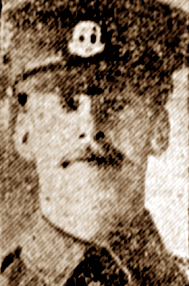 Yet another Lutonian has won a double honour, L-Cpl William Wood (pictured right), whose home is at 60 Ash Road, and who is serving with the Middlesex Regiment, has been awarded a bar to his Military Medal for bravery on then field between April 11th and 19th, by dressing and carrying in wounded men under very heavy fire.
 -
Reported missing during the German offensive of March 21st, Rifleman H. E. Corley (King's Royal Rifles) has sent a postcard from Limburg to his parents at 20 Old Bedford Road, Luton, and it reached them on Monday – over two months after his capture.
-
A workman named George Burrows, of 18 Albion Road, was unloading a piece of machinery weighing about two tons from a railway lorry at the Skefko Works on Tuesday evening, when he slipped and caught his foot in the wheel. His boot was torn into halves and the left foot was severely bruised. He was taken to the Bute Hospital.
-
The story of a short cut across the railway line which proved fatal was related at an inquest at Luton Court House on Tuesday. Deceased was William John Burgess, aged 47, of 30 Shaftesbury Road, Luton, a process worker employed by Messrs Laporte at their chemical works, Dunstable Road. He had apparently been in the habit of taking a short cut across the metals of the Great Northern Railway to reach his work. On Monday morning he was knocked down by a passing train and probably run over, sustaining injuries which caused instant death. His left leg was practically severed below the knee, among other injuries. Engine driver Ernest Jones, of Hatfield, said that with the tender foremost he had not seen anyone on the metals, and platelayer Arthur Rainbow, of 20 Russell Rise, Luton, said he found the body lying face downwards near the Kingsway bridge. A jury returned a verdict of accidental death.
-
The mother of Pte Frederick Dean, who was living at 8 Liverpool Road, Luton, has received the sad news that her son has died of gas shell poisoning at the 5th General Hospital, Rouen. He was admitted to hospital on May 13th and succumbed on the 18th. It was only five weeks since his eldest brother, Pte William Dean, was killed in France while aiding a wounded soldier.
-
Aged 19 and single, Pte Percy Ward (Hertfordshire Regiment), son of Mr and Mrs Ward, of 51 Frederic Street, Luton, was killed in France on April 24th. He had been in France only two months,
-
Information concerning Pte Herbert Ball, 20667, Norfolk Regiment, would be welcomed by his Luton friends. His address was 70 Oak Road, Luton, and he will be remembered as a former licensee of the Four Horse Shoes public house, Park Street. [Herbert Ball was lated posted killed in action on April 15th, 1918.]
-
Prisoners of war or missing: Pte Harold Wiseman (Beds Regiment), 12 Cross Street, Luton; Pte Percy Bodsworth (Sherwood Foresters), 73 Burr Street, Luton; Pte Albert Chamberlain (Royal Fusiliers), 85 Norman Road, Luton; Pte Fred Fensome (Norfolk Regiment), 22 Albert Road, Luton; Pte Thomas Gilpin (Northants Regiment), 21 Ashton Street, Luton.
-
Pte R. B. Orme (Royal Fusiliers), son of Mr W. P. Orme, of 53 Belmont Road, Luton, is progressing satisfactorily though slowly in hospital at Exeter after being wounded in the big offensive. Only three men were left at the gun he was serving and, after defending himself until the last moment, he was attacked and shell shrapnel of considerable size was extracted from his body in an operation at Havre. Before joining up he was employed in the stores of Commercial Cars in Luton.
-
Last week two young men anxious to get into the Royal Air Force made a journey to London to the headquarters. They waited all day on Wednesday, Thursday and Friday for an interview. Becoming impatient they were instructed to see a certain sergeant. They did so, and he gave them a form to fill in and send to the officer, advising them to go home to do it. The address to which the form was to be sent was in the next room to that in which they had been waiting for three days, and one asked if they could not fill it up and send it in at once. “No,” was the reply, “you must go home and send it by post.”