


Excelsior! The title of a Luton Food Committee report is used not merely in exultation over the vindication of the rights of the Press, but because the Committee has now the power, and has resolved to use it, of controlling the supplies of butter and margarine. The scheme was succinctly explained by the Executive Officer and the Chairman, and was unanimously adopted by the Committee.
A preface to this matter, however, was the question of the admission of the Press, and it will perhaps interest our readers to learn why the Committee had reconsidered and rescinded its previous decision.
Less than a fortnight ago the Chairman of the Committee reported that the matter had been further discussed, and the Committee unanimously decided to exclude the Press. Knowing that we had the support of the town, we resolved to prosecute our claim as strongly as we could, for we felt the Committee were adopting an unwise attitude towards the public.
"Subsequently the position underwent a change, and we received a message from the Town Clerk, as Executive Officer, informing us that the matter would again be discussed at the opening of the meeting last night, and that if a representative presented himself he would inform him of the decision as speedily as possible. The meeting was at 7 pm.
The first item on the agenda concerned the minutes of the previous meeting. The second was the admission of the Press, in connection with which were letters from the Friendly Societies Council, the Independent Labour Party and the Scientific Instruments Makers Society. At 7.20 our representative was admitted and, let it at once be stated that in the subsequent proceedings not a word or a sign was given that he was an intruder.
Alderman J. H. Staddon was in the chair, and others present were Mrs Staddon, Alderman E. Oakley; Councillors W. J. Primett, A. B. Attwood, C. Yarrow and J. Bone; Messrs W. E. Sanders, H. Inwood and W. Ball; with the Executive Officer (Mr W. Smith).
The Chairman explained that in view of the changed circumstances wrought by the wider powers which had been conferred upon the Committee since the last Town Council meeting, and which at last enabled the Committee to take definite action, the position of the Press had been reconsidered by the Committee, and the Press would in future be admitted. He was not going to lecture on the duties of the Press, but trusted the same discretion would be exercised as at the Tribunal meetings.
The undertaking was readily given by the Luton News reporter.
The particular action of the Food Controller which had led to the admission of the Press was the Margarine Acquisition Order, which was submitted by the Executive Officer, with the explanation: "This is the first Order to give the Committee any power at all." Issued on December 20th, it reached him on Christmas Eve.
With a view to securing a proper distribution of margarine within an area, it gives the Committee power to require or direct any persons who sells margarine by retail within the area to hold at the disposal of the Committee such quantities held or assigned by him, as the Committee may determine, and deliver the same, whether in bulk or not, to the Committee or such persons as they name and advise, in such manner as the Committee may decide. The Committee are to pay the maximum price (one shilling, Oleo margarine 1s 4d), together with such further sum not exceeding ½d per lb, as may appear to be just.
The Executive Officer referred to the action of certain committees and Executive Officers who, on receipt of the Order, seized stocks. He said that after considering the matter with the Chairman, he did not see any need to do that.
There was no big queue in Wellington Street. He went on to explain that during the course of last week, much against his will - (laughter) - he accompanied the Chairman to Wellington Street, and he asked the police inspector controlling the queue if he had any suggestion to make. THe inspector suggested tickets for those in the queue who were unable to be served on that occasion, so that they might be able to be the first served when the shop was re-opened.
Thus those who had been successful would not get two supplies while the others did not get one. It lifted the difficulty a little, but was no sooner in operation than people complained of favouritism, saying that some of the holders of the tickets were friends of the police and the Committee - (laughter). He went on to say that when the particular shop was closed at noon on Saturday there were less than 20 people in the queue who were not served. On Monday there were not 20 people in the queue when he went with the Chairman and stood in it, and in less than three minutes they were in the shop and out of it very quickly.
The margarine was then nearly exhausted and they saw the shop close, He did not think there were five people in the queue who were not served. Only five tickets were given out, and the holders had the right to stand first at 4.30 when the shop was re-opened.
"I am going to be perfectly straight and open," said the Executive Officer, "and I am going to say that the shortage has not been nearly so bad as some people make out, and that there would have been no necessity for the queues had it not been for the scandalous attitude and the awful greed of certain classes of the community. The total quantity required by the public of Luton at ¼lb per head is 6½ tons, and that quantity and more came into Luton last week."
Alderman Oakley explained the position of the shopkeepers, stating that the deliveries were periodical, and in order to prevent exhaustion of stock in any one week they had to reserve some for the week after. The small shopkeepers had to requisition from the wholesalers, and got a third. That had to last them for the rest of December and until towards the middle of January.
The Town Clerk repeated that it was nothing but the awful greed of a number of people who laid in stock for Christmas at the expense of their neighbours, and it was not the better class on the community that did it. He pointed out that the particular shop where the queues had been in evidence in Wellington Street had met the Committee in every possible way.
The Town Clerk then went on to explain in detail the coupon scheme. A card of coupons would be supplied to each household - one coupon available for each household for a week. Each person in the household was allowed not more than ¼lb per head per week. No person would would be served unless producing a coupon, and when the coupon had been once met it would be impossible for that person to get a second supply in that one week.
He emphasised the fact that people should not run away with the idea that they were entitled to the full quantity at the rate of ¼lb per person. They could only have what was available, but by this coupon it was hoped they would secure equitable distribution and 'kill off' at least a third of the queues.
The Town Clerk said he hoped people would apply as early as possible for their coupons, bringing their sugar tickets with them to the Town Hall.
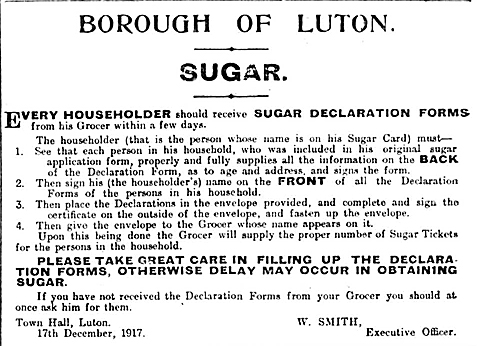
Some very strong expressions were made concerning the communication from the Food Ministry with reference to a matter affecting Messrs Hayward Tyler's new canteen. THe firm had applied for a sugar supply.
As the application was late and on the grounds that the employees of this firm had already been catered for under the Sugar Scheme, the Committee did not entertain the application. The firm had written to the Food Ministry stating that the canteen was a new idea or they would have put in an application earlier. The Food Ministry replied asking the Committee to reconsider their decision and pointing out two clauses in the regulations applying to works canteens of this description.
The Town Clerk pointed out that unless the Committee granted the Committee, the firm would be supplied by the Food Ministry, and he did not think that was desirable.
The Chairman said he understood the original application application was for breakfasts and dinners, not merely teas. The point was that these workers were already catered for by the Sugar Scheme.
Councillor Attwood said it was not fair that munition workers should be allowed to have a special allowance at these canteens and get the same quantity as other individuals.
Councillor Primett said it was a bigger question than sugar. It applied to several things, and he agreed with Councillor Attwood.
Councillor Yarrow said the munition workers were pampered too much by half. They were paid more than other people, and then they had special considerations.
The Chairman said they should throw the responsibility on the Food Ministry, and this course was agreed to. On the motion of Councillor Bone, the Committee adhered to their former decision.
At the conclusion of the meeting, a considerable portion of which had been occupied by a variety of instructions and orders from the Food Ministry which gave the Committee no power whatever, the Chairman said to the Luton News representative: "This only emphasises what I have already said. From the beginning we have had heaps of papers of these forms and orders without being able to originate any scheme ot take any definite action whatever."
[The Luton News: Thursday, December 27th, 1917]