

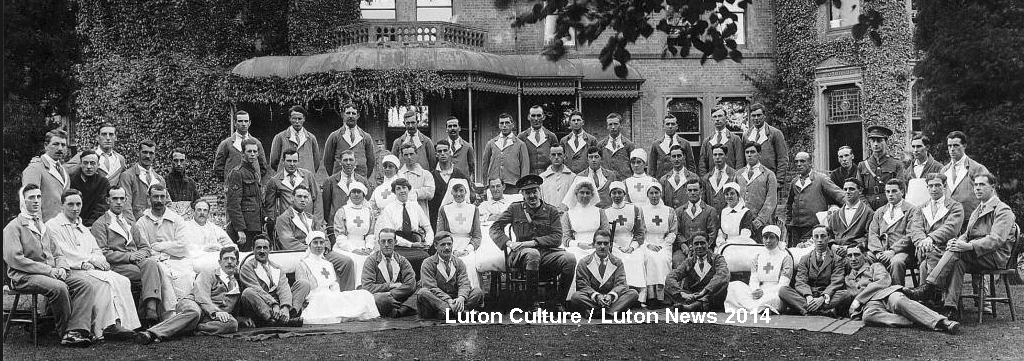
- Wardown Hospital patients and staff.
Of all the organisations which have been tested and tried in the fiery furnace of war, none has emerged from the crucible with a greater reputation than the Voluntary Aid Detachments, which are now to be found throughout the length and breadth of the land.
In what we today regard as those far-off days before the war, it is at least a matter of some doubt whether the ladies who banded together to form local units of the British Red Cross Society never really believed there would come a period when their services would be demanded. But the conflict of 1914 answered the question in the affirmative and, as has so often been the case in history, the call did not fall upon deaf ears.
Less than a month elapsed after war was declared, in fact, before the first of the V.A.D. branches was utilised by the authorities, for it was at the latter end of August when one of the Kentish coast branches was requested to organise for the reception of Belgian refugees, following immediately upon the evacuation of the civil population of Antwerp. Once started, the operations of the V.A.D. grew apace, until at the present moment they constitute one of the most highly important unit in our vast wartime regime.
When Luton's detachment was brought into line there was no lack of patriotic enthusiasm to accomplish to the utmost what the occasion demanded, and the fact that December 1st will witness the completion of two years of splendid service at Wardown Hospital directs attention to the value of the work which has been carried on.
There is no necessity to enlarge upon the manner in which these establishments have made their appeal to the persons most nearly concerned - the troops who have been treated and nursed back to health within their hospitable walls. The fact has been noted time and again, and there can be no two opinions as which of the two classes of hospital - V.A.D. or military - Tommy prefers.
As an inmate once put it to the writer: "In a military hospital they do certain things for you because it is prescribed in the regulations. In a V.A.D. the nurses look after you because they want to. You can appreciate the difference?"
And the passage of time sees no slackening in the splendid spirit which underlies all this voluntary labour. Changes occur in personnel, old friends learn the intricacies of nursing and graduate for a wider sphere of service, nurses come and nurses go - but the place, and the spirit in which it is administered, goes on apparently (like Tennyson's brook) for ever.
If it is true in any direction, assuredly it is true of the V.A.D. Hospitals and their staffs that 'virtue is its own reward'. But the other aspect of the question is that the organisation's services to the common cause are such that public reference is occasionally necessary, for their is an uncommon tendency on the part of the people to take well-established things too much for granted.
Nevertheless, the V.A.D.s have had always the keen and generous support of the public. Without that adjunct it is certain their activities must have been seriously curtailed. No appeal for support, however varied its character, has yet failed to elicit a prompt and worthy response.
Particularly is this true of Luton and Lutonians. Since the hospital was established at Wardown two years ago there has at no time been any lack of service or supplies, and the authorities bear testimony to the continued generosity of all classes of the town's inhabitants.
This spirit of appreciation and desire to help was further exemplified on Thursday afternoon, when a quite informal sale of work was held at Wardown. The event, which was highly successful in ever way, owed its inception to the Misses Tomson, of Bedford House, New Bedford Road, two members of the nursing staff. The object was to raise funds with which to provide Christmas parcels for former patients who are once again bearing the heat and burden of the fight on various fronts or who have had the misfortune, since departing from Wardown, to become captives of the enemy.
Originally proposing to hold the sale at Bedford House, the promoters subsequently decided, seeing the eagerness with which the suggestion was adopted by those concerned, that it should take place at the hospital. A fine array of useful and fancy articles was forthcoming from many friends, and embroidered articles worked by several of the Wardown patients also found a place of honour on the stalls.
Invitations were confined to the members of the nursing and kitchen staffs and, in view of the semi-private character of the sale which was held in the Recreation Room, a formal opening ceremony was dispensed with. The visitors were conducted over the premises by the nurses, and evinced keen interest in the hospital and its administration. The stalls were completely cleared of their contents, and at the close the staff had the pleasure of learning that approximately £30 had been realised for the provision of welcome parcels on the lines indicated.
Wardown is in all respects admirably suited for conversion into a V.A.D. hospital, and has been run since its establishment by the Luton branch of the British Red Cross Society, which was formed in 1911.
Practically since the start the accommodation of the place has been fully utilised, there being 60 beds. On some occasions, in fact, there have been more than this number at one time. Comment on the value of the work performed was recently to hand in the announcement that three members of the staff had been included in the first list of those selected for decoration under the new British Empire Order.
[The Luton News: Thursday, November 29th, 1917]