

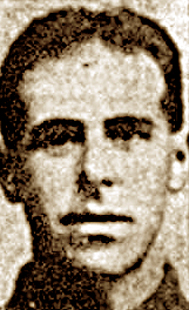
Bdr Ernest Palmer (153697, Royal Garrison Artillery), who for many years working in the printing department of The Luton News, has sent home some very interesting letters to his brother and sister, who reside at 154 Leagrave Road, Luton. Bdr Palmer (pictured below) writes:
"I've got my wish for I am seeing some of the world at any rate. We left the rest camp on Saturday night, were travelling all day Sunday, and arrived at our present quarters about midday today. Altogether we spent 42 hours in the train. It wasn't a bad journey but rather wearying, as we couldn't get proper sleep. The arrangements for feeding is en route were excellent.
"The weather is grand and getting rather warmer as we proceed southwards. We were well received by the people at stations en route, and there was some fun when changing cash. By Jove, the French are 'some twisters!'
 "The railways in the north are badly laid and tortuously slow, and mostly on the ground level or running through the streets, these being fearful byways. Perhaps I'm piling the jam on too thick, as we only went through the outskirts of one town.
"The rural roads, as viewed from the 'bus,' were generally well made. The gardens are well kept and allotments look fine. There is an abundance of fruit, and peaches grow everywhere, more plentiful than plums at home. What struck me most were the vineyards. You have seen the hopfields of Kent, so will gather some idea of these when I say the vines grow exactly the same except they do not grow so tall, 3ft being the general height.
"The houses in the town were squalid places, all windows provided with shutters and all coloured greyish. In the country were some fine chateaux, and the commoners' houses seemed to be more substantially built, mostly square, of granite or grey sandstone.
"Coming more south, it was nothing to suddenly come round the side of a hill and find a village neatly built into the side, Here were also to be seen innumerable caves now in occupation.
"The French railways seemed to be built on the figure eight system, and it was nothing to see the engine driver almost shake hands with the guard, the country is so hilly. Barton Cutting I always counted as the best bit of scenery I've ever seen, but I've changed that view now. The foliage is grand - long rows of tall, fine poplars and chestnuts, all planted with perfect symmetry.
"There are more besides out battalion here, and we make a jolly happy crowd. We can almost thank Kaiser Bill for providing us with such a good outing. At any rate, we'll do our best to return his 'kindness' when we get settled in our 'little shop'."
A few days later, Bdr Palmer wrote another letter, in the course of which he says: "Everywhere we get a most enthusiastic reception. At one station they brought us coffee and black bread. At another, Red Cross nurses brought cigarettes, papers and postcards.
"We see mountains anything up to 10,000ft high, snow-capped and yet cultivated up to 4,015ft. Every Frenchman has his own vineyard, corn or maize patch. These people are very thrifty. One looks up the mountain side and sees every available yard under corn or maize, and these are laid out in little terraces and look very beautiful.
"As we proceeded south, the vineyards grew more extensive. The mountains are a tremendous height. Compare a thimble to Dunstable Downs and you will get some idea how high they are. The rushing mountain torrents, ravines, gulleys and the rough mountaineer shacks all go to make an indescribable scene.
"On the French side much of the novelty was lost owing to the continuous heavy downpour, which lasted until we crossed the frontier.
"Of course, most of the travelling is through tunnels, and it is the panoramic beauty between these that firmly impresses itself on the mind. In the mountain regions the railways are overhead, electrically driven. We passed through one tunnel at least 10 miles long. We were over half an hour going through.
"On this side even the villages lay in terraces on the mountain side, and each hamlet has its 'kirk,' some being most quaint buildings. On coming out of one tunnel we suddenly caught sight of an A.S.C. motor lorry gradually winding its way up the mountain side. What a difference in the climate in a couple of hours! I was bitterly cold while crossing the top, but when we got the 'level' it was hot.
"The Italians are a funny race. Their hovels are all crowded together as compact as can be; never a bit of glass in the window frames. All windows are shuttered, and their houses are always of a bright colour.
"The women do a lot of work in the fields, even haymaking. Oxen are used about thee as great deal in place of horses, but it is a very slow means of transit."
Writing on September 5th, Bdr Palmer said he could never remember anything approaching the heat, 'unless you can call to mind a Saturday some ten years ago when Luton played Queen's Park Rangers, when so many players and spectators had to be taken off the field'.
"There is nothing to interest one here unless one makes one's way to the siding to see if so-and-so has arrived, or to say 'au revoir' to some fellow you hadn't seen until 48 hours ago, but still have been 'chummy'.
"I can understand the necessity of that line at the bottom of magazines - 'when finished with, hamd in at the POst Office for use of troops'. These rest camps are a good deal worse off than permanent camps in that respect."
[The Luton News: Thursday, September 20th, 1917]