

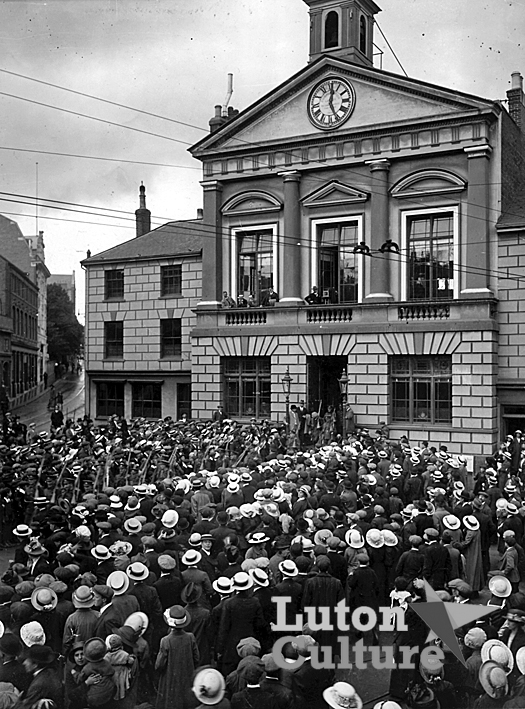
- Territorials off to war in August 1914.
The fourth of August has come round for a fourth time as a day of war and, although locally it has not been recognised publicly to any great extent, this beginning of the fourth year of strife is an opportune time to glance back and sum up something of the part the town has played since was was declared.
We all remember the excitement which was created when the news of that noble declaration was received. Only the saner minds realised, or admitted the possibility, that the fight on which we were entering was likely to be long drawn out, or that the Army would have anything but a picnic of a few months' duration, rounding up with a glorious victory.
Our Territorials, just gone into their summer camp, struck tents and returned to their headquarters, and the only thing men who were anxious to have a hand in the fight wanted to know was whether it was going to last long enough for them to get 'out there' and strike a blow for the credit of the British Army, for liberty and freedom, and for the welfare and immunity of the little nations of the Continent.
Well, for three years we have been sending our men forth to the fight, and still we have to send them. In the little Army of Regulars which went out in the beginning of things to stand all the terrible hardship and loss of those early days of open fighting against the tremendous weight of the German military machine, the Bedfords played a gallant part.
When the Dardanelles campaign was proceeding with its worst fury, the Bedfords, but this time our own Territorials, fought gallantly and paid a terrible toll. And in that area, though their work did not bring them so much into the limelight, our local Engineers and R.A.M.C. were also carrying on in the time-honoured, undaunted style of the true British soldier.
Then there was a memorable month of May, in which some of the London Territorial Battalions covered themselves with glory in France, in taking and holding, both at terrible cost, ground which probably would not have been taken or, if taken, would not have been held by soldiers of any other Army but that which, according to the 'All Highest,' was so little and contemptible.
Elsewhere in France a Territorial Division, known as the North Midland, were doing similar deeds of valour and winning undying fame.
Before the war, the deeds of those London Battalions, or the Welfare of that North Midland Division, would have excited little local interest. Perhaps we hardly knew they did form a part of the British military system. But at different times they came here for their training and swept into their ranks many a gallant Luton man; so when they came to figure prominently in the daily roll of honour, a proud sorrow was brought to many a Luton home.
The Yeomanry, too, although for a time they seemed lost or overlooked in the loneliness of their training ground, found that all in good time there was bold work waiting for them to do, and they did it.
In this past third year of war we have perhaps not heard so much of what our very own men have been doing. The toll of life has been steadily taken, and every week more and more homes in the town and neighbourhood have been added to the list of those who have given their loved ones for the cause of right as against might.
But the veil which has always hung between us and 'the line,' never very transparent, has from time to time increased in density, and only of late has it been lifted to the extent of letting the British public know, not only what the Canadians, the Australians and the New Zealanders were doing for the Motherland, but also occasionally letting them know of a home regiment responsible for an effort which, among other notable efforts, has been of outstanding brilliance and bravery.
Perehaps, therefore, we shall yet hear again in detail of what some of our own men are doing, and not have to rest content with any snatches of news to supplement our knowledge that in France, Belgium, the Balkans, Egypt, Mesopotamia and elsewhere where fighting is taking place, not forgetting sea and air, Luton men in bodies or in scattered numbers are 'carrying on'.
Really, war matters in the town have been of a much more humdrum character this last year. Compulsory service, by its introduction, wiped out the necessity for those big efforts of early days to stimulate recruiting, and now the principal, and about the only thing we hear of this side of war is the effort of the Military Representative to take into the net men who for business of domestic reasons believe they should be exempted; or of the misdeeds of a Medical Board in taking into the Army men who by physical infirmity are obviously unfitted for anything but civil life.
The financial side, it is true, did excite some public stir, and we are glad to say Luton did very creditably in support of the Victory War Loan.
War shrines which have made their appearance here as well as in other towns give convincing evidence of the full extent to which some of our streets have contributed to the fighting strength of the nation, and while there are hosts of people to whom war is admittedly a good thing from a money point of view, when such a toll is taken from our breadwinners as is evidenced by these shrines, there must inevitably be some cases of distress, some cases of trouble and disaster which can hardly be measured in terms of pounds, shillings and pence.
To deal with these cases, a strong Guild of Help has taken the field, and as its workers include men and women of considerable experience and ability, it is reasonable to hope that in a large measure the Guild may alleviate suffering and prevent tragedy.
Some day we hope to return again to something approaching normal conditions of life. At the moment very few will be willing to prophesy how soon that will be. True, not many days ago someone high up in military circles spoke of the possibility, even probability, of the fighting being over by the end of November. What sure foundation there may be for such a statement the man in the street cannot judge, and on the whole people who three years ago were willing to fix a date for the termination of hostilities will be chary of doing such a thing now.
But if we cannot prophesy, we can all legitimately hope that the time is approaching when we can end the fight, and that not before we have attained all we set out to attain. With this possibility in view, reconstruction is already engaging attention.
If this fourth year of war is marked by the victorious return of our brave men we shall all be glad, but big problems will arise. The absorption of thousands of men into their original occupations, together with the suspension, at any rate partial, of many forms of labour which have been carried on at such an intense pace in order to supply the requirements of a tremendous Army and Navy, cannot but cause some industrial troubles. And there will be work for wise minds is these things are to take place with the minimum of friction and difficulty.
True, many of the larger towns will be able to help in the solution of the employment question by putting into effect many schemes held up by the war, but this will be only a partial solution of the difficulty. In so far as it is a solution, however, it will operate here as in other towns.
As we know, apart from work which private employers want to put in hand at the earliest moment, public authorities will have to renew their consideration of extensive schemes. There is the provision of a new secondary school for girls on a site lying between New Bedford Road and Biscot Road for which plans are ready; an elementary school for that quarter of the town between Biscot Road and Leagrave Road, where the population has increased so rapidly in recent years, and where a new school was badly needed even before the war began; a new and bigger footbridge across the railway stations which would have been completed some time ago had the war not upset things; the Spittlesea Hospital scheme; and various other important works.
Nobody will expect these schemes to be got into full operation a few days after peace is declared, but they are all schemes which must be entered on speedily when present reasons for delay no longer exist.
Then there is the question of housing. At the moment, when imported labour has so considerably affected the question, it would be difficult to even approximate the extent of what may be regarded as fixed population, and that of what may also be regarded as floating population.
Perhaps when war requirements are less pressing other outlets may be found for the product of all this labour, which may therefore be converted into an abiding population. At any rate, we are assured that some firms will have ample work to do for a long time after the war ends.
This being so, and having regard to he cessation of building for domestic purposes which now prevails, we know that serious consideration is being given to the present crowded - we might perhaps say overcrowded - condition of the town, and there is the possibility and probability that bold spirits will be found to urge vigorously the desirability of the municipality entering upon a scheme for artisans' dwellings. Whether this will materialise or not remains to be seen, but at any rate it is a matter the possibility of which has not been forgotten. For the moment, however, and as long as necessary, we go on fighting, or, if we cannot fight, providing the wherewithal to keep those who can fight.
There was a talk at one time of a county record of all the men who had gone into 'the Field'. That was in the voluntary days. What a list it would be if it could be compiled now; and what deeds of devotion and sacrifice it could record. Of those alone who have found their last resting place on foreign soil there would be a brave chronicle; and also of those who, by their outstanding gallantry, have won special honour and decoration; while for those who have just done a noble duty without special reward, the list would be enormous.
Perhaps there will never be a complete record, but if it is found possible, what a grand tale it will tell to future generations.
[The Luton News: Thursday, August 9th, 1917]