

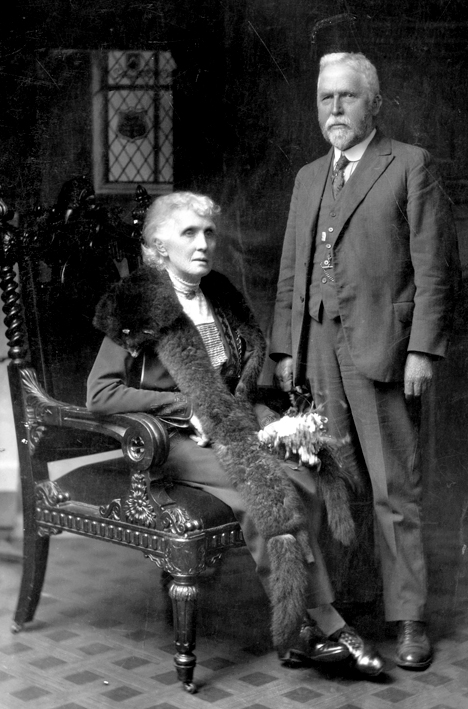
- Thomas Hobbs and his wife Elizabeth in 1926
On July 7th, 1917, the biggest German air raid on London to date took place. Extensive damage was caused in the East End and 57 people were killed.
Among those caught up in the incident was Luton businessman and photographer Thomas Hobbs, who arrived back from the capital in time to give his account to the Saturday Telegraph that was printed the same evening.
"I was an eye-witness of the raid," he said. "I first noticed the people looking upwards and, realising what was on, I hurried to a point whence I knew I could see, and where I knew also I should be able to find shelter. I at first saw one or two aeroplanes, and then a large number - quite a flock - and counted 22 of them. I believe there were more.
"I found the persons employed at the place where I went to seek shelter had already stopped work and were going to the basement. By this time the aeroplanes were getting uncomfortably near and appeared to be making for directly over us. Then, suddenly, the main body seemed to swerve as if travelling directly for St Paul's.
"Two or three, however, broke away and, then as I saw the shrapnel bursting, as it seemed, around and among them, I felt it imperative to take shelter. I went below with a lot of workmen, where we hugged the main wall.
"Several detonations sounded as if approaching us, and a few of them seemed apparently within a few yards, but this assumption proved not to be correct. The loudness of the explosions, however, was terrifying.
"I went down into the basement at 10.33. I had noted the rapid flight of the machines. In three minutes the sound of the bombs had passed, and because of the stillness we ventured to come out into the open - and, behold, they were gone, and I saw them no more."
Mr Hobbs described the subsequent scenes - flames bursting out in two quarters and in the near vicinity hurrying fire engines with bells ringing, and motor-cars laden with injured for the hospitals.
"I then decided to return home," said Mr Hobbs and, illustrative of the irony of things, he told us that on the way he learned that a building known as the German Gymnasium had been destroyed by the German bombers.
The train on which a Lutonian soldier coming home of leave was brought to a standstill and a few minutes later, far up in the sky, a series of specks appeared - over 30. They passed over the train, heading towards London, and soon the dull thuds of dropping bombs were heard. "It was an awful sensation," he said.
Official news of the raid reached the Telegraph around 1pm the same day. The announcement in bold type was carried in the windows of the Luton News/Saturday Telegraph offices at the corner of Manchester Street and Alma Street and the building became "besieged" by townspeople anxious to learn about the raid.
[Beds & Herts Saturday Telegraph: July 7th, 1917]