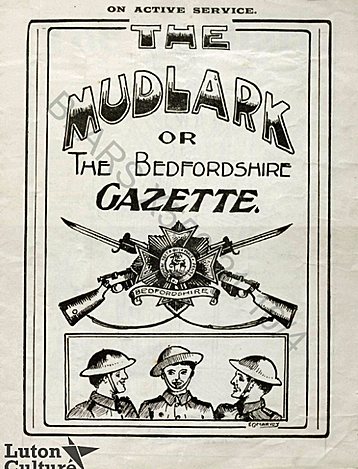
The Mudlark, otherwise the Bedfordshire Gazette, originated by officers of the Bedfordshire Regiment, who, weary of the monotony of warfare in the trenches, endeavoured to produce a little paper to interest the men in the battalions, and to give the men in the regiment who possessed any literary talent, an opportunity of contributing verses, articles, stories, drawings or sketches. It is full of wit and interest.
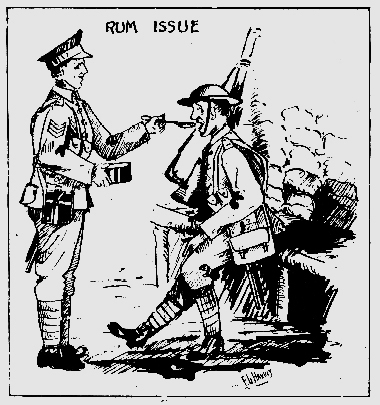
That was how the Beds & Herts Saturday Telegraph of March 31st, 1917, summerised a publication that had become popular with local fighting men at the front. It also pointed out that the front page (an example reproduced above) was the work of a named former Luton schoolboy who also contributed clever pen and ink sketches such as the one - "Rum Issue" - published below.
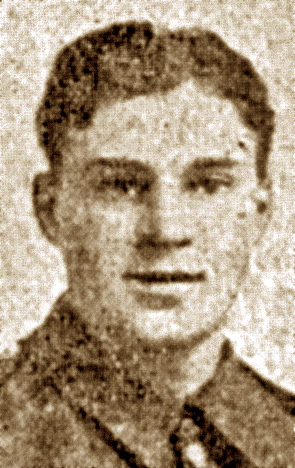 L-Cpl Edwin Granville Harvey (pictured right), aged 21, was killed by a shell at Longueville in the advance on the Somme on July 24th, 1916. To his mother Alice, who had lived in Luton until shortly before her only son's death, her bound volumes of The Mudlark with her son's picture at the front represented a mother's remembrance.
Although born in East Ham, London, Edwin Harvey had been brought to Luton with his family and attended Christ Church Boys' School. Headmaster Mr W. H. Hyder remembered him as an excellent draughtsman whose talent grew as he developed.
Mrs Harvey eventually wrote to Mr Hyder from her then home in Poplar, London, and referred to The Mudlark. She wrote: "Ted (her son) did the covers and most of the sketches. It is the only souvenir I have got of my dear son, so I have had them bound together, and as most of the staff have given their lives in the big sacrifice for those they love and their dear Homeland, I thought it would be interesting to you to see how our boys passed their time when not fighting in the trenches."
Mrs Harvey also enclosed a cigarette case which was given to her son by the Y.M.C.A. at Rouen for work he performed while convalescing there after being gassed in May 1915.
In continuing her letter, Mrs Harvey wrote: "It is greatly due to the masters and teachers of the schools that most of our brave young soldiers have gone forth to do their duty fearlessly and well. The masters always took such pains to teach the boys to be straightforward and honest in all their dealings, and you all have something to be proud of in the way they have repaid you. They are one and all heroes, some of them the finest England can boast of.
"If I could only hear where my beloved Ted was buried, I should feel more content, but I have written everywhere and they cannot find out. Other mothers have nice letters from comrades and clergy. I have none, and feel it very much, and can only come to the conclusion that those who knew him shared his fate."
L-Cpl Harvey, said the Telegraph, had "endured 16 months of the horror of war. He was buried in a soldier's grave 'somewhere in France'. With that information a broken-hearted mother has to rest content. The labours of love of such women and England's mothers will live for all time, and the ages shall ring with the praise of the woman who set their men free to fight for their God, their country and their King."