

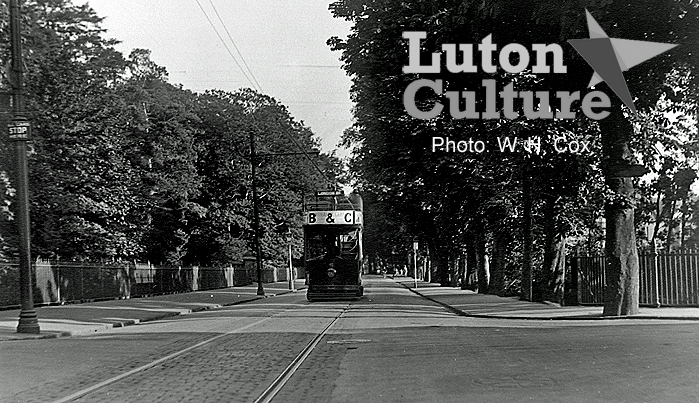
- New Bedford Road near the spot where two escaped German POWs were recaptured.
After a few hours of freedom and a tramp through the night along the country roads, two German prisoners of war who escaped from the internment camp at Woburn were arrested by two soldiers in Luton on the morning of Tuesday, November 28th, 1916.
The two men were last observed when a working party returned after dinner at half-past one the previous day to where they were engaged in the woods of Woburn Park. But it was not until roll call at quarter past four that their disappearance was noted.
In the belief that they were hiding among the trees and thickets,the wood was surrounded by troops while search parties worked their way slowly through, but the search did not bring any result and a hue and cry was instantly set up among the police and special constables in the surrounding locality.
An official description of the men issued by Scotland Yard gave their names as Carl Schwarz, 5ft 9in, slim, dark featured, black eyes and slight grey moustache, and Paul Hubner, 5ft 7in, thick set, repulsive looking, brown eyes, clean shaven, sallow and walking with a stoop.
Both men were dressed in a field grey uniform, and when they left the camp they had on caps with red bands, one being peaked and the other without a peak, but when they were arrested they were each wearing civilian caps. Schwarz wore the ribbon of the Iron Cross, a black ribbon with two narrow stripes of white at either side, and also had in his possession papers showing how he had been awarded the Iron Cross for the extinction of a British gun crew.
The recapture of the two wanted men was quite an unexciting affair. It seems that shortly before eight o'clock on Tuesday morning, two officers' orderlies of the R.F.A., whose duties take them to some stables in Cromwell Road, had their attention casually drawn to two men in grey uniform in the New Bedford Road, and the fact that the two strangers seemed ill at ease and rather anxious to avoid notice led the soldiers to go across and make investigation.
Directly they were approached they put up their hands and, when asked who they were, replied in poor English that they were Germans. The soldiers were rather taken by surprise by the chance discovery, for up to that time they had no information of the escape of the two Germans from their internment camp, and they instantly escorted the prisoners to their officers.
The Germans made no show of resistance - on the contrary they seemed tired out and done up and very glad to go, and they were removed to the Biscot Camp and placed under lock and key while inquiries were made.
Later on in the morning, when their identities had been established, they were taken to the military detention quarters at the Luton Union house, where they were provided with a bath and a meal and kept until the arrival of an escort to convey them back to Woburn by motor car.
[The Luton Reporter: Monday, December 4th, 1916]