

Digest of stories from the Beds & Herts Saturday Telegraph: June 15th, 1918.
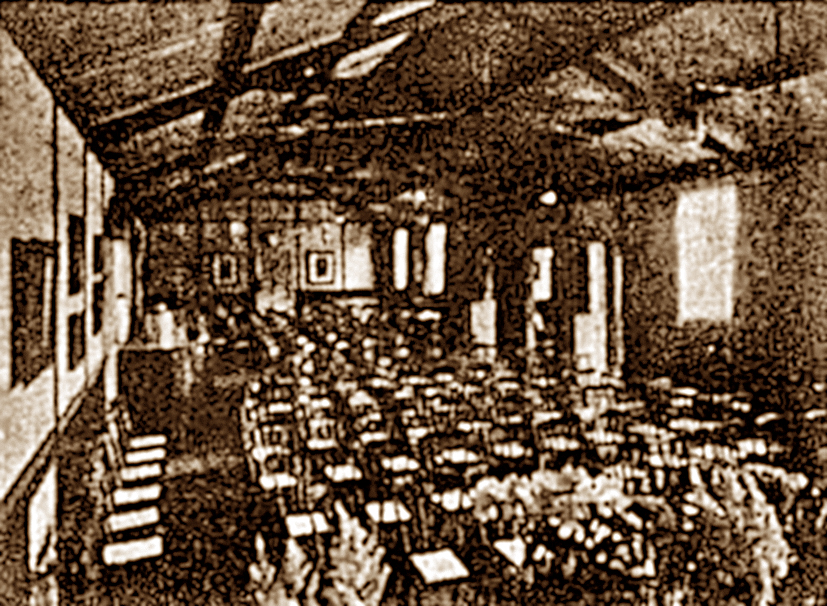
The work of the YWCA in Luton is of ever increasing value and usefulness. Under the direction of Miss Forman the Club [in Upper George Street] has increased its power and influence in the social life of a large section of the girls of the town.
The summer activities have spread in various directions. Through the generous help of several good friends the girls now have excellent swimming and tennis clubs, and a cycling club is rapidly approaching a successful stage. The country rambles and the efforts at gardening are deservedly popular, and the occasional free and easy evenings indoors are well liked.
On Wednesday Mrs Crawley presided over a meeting of the committee to settle the details for a one-night shelter for girls who come to take up work in the locality, but who, arriving late in the day, are unable to find lodgings. Miss Forman has never yet failed to do all that she could for any girl stranded in this way, despite the fact that the existing building has no bed accommodation, and on one occasion she had as many as 13 girls in the lounge for the night.
Now the Ministry of Munitions has granted the sum of £100, and extension plans have been made, subject to the approval of the Town Council at the next meeting. The sleeping quarters will take the form of an extension from the front building, and there will be accommodation for four beds as well as a bath and other essential fittings.
-
The Tennyson Road Infants School has been closed for a month by order of the Medical Officer, but reason of the fact that an epidemic of diphtheria has occurred. Last evening about five cases had been reported, and there is no doubt the spread of the infection was due to carrier case in the school. The infection has been traced to its source, and we are assured the epidemic will soon be entirely stopped. There is no cause for concern in the Tennyson Road district, provided all parents take the usual reasonable precautions.
-
In well-informed circles at The Hague it is understood that the Anglo-German conference on the exchange of prisoners is making good progress. An arrangement may be reached within a few days. The principle of man for man repatriation for men with more than 18 months captivity has been adopted by both parties – Ex Tel.
-
Among the local men recently captured by the enemy are: Pte W. Dumpleton, whose home is at 24 Gardenia Avenue, Leagrave; Pte H. F. Rogers, 32 Maple Road, Luton; Pte W. E. Guppy, 12 Harcourt Street, Luton; Pte H. Nicholls, Summer Street, Slip End; and Pte Percy Bird, 108 Althorp Road, Luton.
-
Among the recipients of birthday honours appears the name of Sgt W. Fowler, Tank Field Coy, who previous to the war was employed by Messrs George Kent Ltd, Luton. He has been awarded the Distinguished Conduct Medal. In 1914, soon after the outbreak of war, he joined the R.A.M.C. And was transferred to the A.S.C. And subsequently to the Tank Corps.
-
Storms have been threatening during the last two days, and an exceptional one – both in severity and brevity – broke over the district this afternoon. Only the fringe of it passed over Luton, when rain fell for a few minutes, but at Dunstable large hailstones fell thickly for a long period.
-
The wedding took place at King Street Congregational Church on Thursday of Lieut E. Dickinson, attached Royal Engineers, who had been in Mesopotamia since October 1916, to Miss Susie Hurst, younger daughter of Mr and Mrs William Hurst, of 2 Whitby Road, Luton. The bridegroom is the eldest son of Mr and Mrs J. W. Dickinson, of Shorncliffe, Havelock Road, Luton. Later in the day the bride and bridegroom left for Yorkshire, where they are spending a short holiday.
-
At an occasional Luton Borough Court yesterday, Alfred Charles Lenners, 41, described as an Austrian and as a former ship's steward not living at Slip End, was charged with stealing a pair of boots, value four shillings, the property of Edwin J. Brown, Park Square, between May 25th and May 30th. Chief Constable Griffin said prisoner was an Austrian who had been released from an internment camp for work of national importance. He had been working in his spare time at Mr Brown's shop, and had taken several articles. The prisoner, who had nothing to say, was remanded in custody until Wednesday next. [At the later hearing, Lenners, then described as a Bohemian, was bound over in the sum of £20 for six months to come up for judgment if called upon, and was ordered to pay £1 2s 6d costs.]
-
There was a very strange and unexpected meeting in Saskatchewan, Canada, recently. Two Luton girls who had worked in the same factory here and who had not seen or heard of each other for nine years came face to face. Their surprise and delight may be imagined, and in talking we have no doubt they did their best to make up for lost time.