

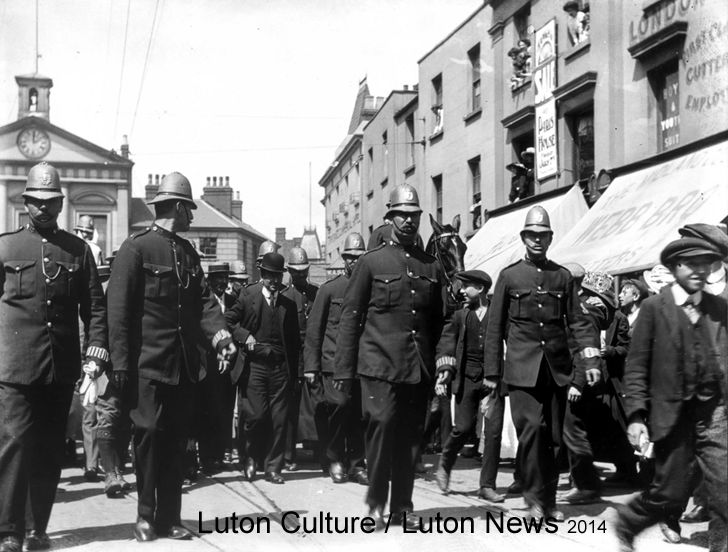
- By-election 1911 when Cecil Harmsworth became MP for South Beds in the last all-male vote.
In February 1918 the Royal Assent was given to an Act of Parliament extending voting rights to woman aged over 30, subject to minimum property qualifications. It meant that several million women in Britain would have a vote for the first time in any future General Election.
Among them was Lutonian Mary Hughes who wrote an article in The Luton News of April 4th, 1918, headlined "What shall I do with my vote?" Unfortunately she gave no further clues to her personal circumstances, but this is what she wrote:
I do not think it is necessary to discuss any longer the question whether women have a gift for politics. There had always been a natural and easy answer to that question - some have the gift, and some do not have it, as with men. But be that as it may, we are voters now - six millions of us at least. the full privileges and responsibilities of the franchise have been given to us by the deliberate will of Parliament. And, as a result, we have the power not only to influence but to shape local and national politics as never before.
This marks a new era in the domestic history of our country and, not withstanding the preoccupations of the war, it is not too soon for us to begin to think what we shall do with our votes. At the General Election which we are told is to take place in the autumn we shall be put to gthe proof, and then, as far as in us lies, we shall have to justify the trust reposed in us.
If, unhappily, the war is not at an end when the Election comes on, the main issue before the country will be clear enough. It will be our duty to return to power a Government whose policy will be not only to secure what Mr Asquith called "a clean peace," but to insist on such a settlement of international affairs as, humanly speaking, will put an end to all war.
This war has brought into many of out homes a desolation from which they will never recover. we women have endured sorrows and privations which cannot be told, and we have done this willingly for the sake of the great ends which only great sacrifices can achieve. But we would not, and must not, allow the children who may be spared to us, and the generations that will follow, to be exposed to such horrors as we ourselves have had to endure.
It is in the interest of women even more than of men to see to it that this awful strife ends in a League of Nations, which will destroy for ever the curse of militarism and secure the ordering of international affairs on the basis of reason, justice and honour, and on nothing less. Our votes must be cast for a Government that will set its heart on this ideal and work for it with a resolute will.
Nor must we think only of the end of the war; we must look beyond it. We shall then pass into what we hope will be virtually a new world, and in the shaping of that new world women will have a large part to play. We cannot tell what it will be; but at the very least it must be a world in which life will be healthier, brighter, easier and nobler for us all. Our politics, accordingly, must be shaped with these ideals in view.
Upon three or four primary things it will certainly be our duty to insist.
1) Better housing. Yes- we shall want better housing than ever we have had, particularly in our big cities and in the crowded areas of our provincial towns. We shall want more light, more air, more room to live. Our aim must not be so much to build cottages and tenements as to provide homes for ourselves and our children, and women must see to it that they have a real voice in determining what the new housing is to be. The making of a home is primarily a woman's business.
2) A living wage. Without this we cannot hope to make and keep the homes we want to have. It is no doubt too much to expect that the high wages that are being earned on war work will be continued when the war is over. Many women especially will have to be content with less than they are getting now. But there must be no return to the standard to which we have had to reconcile ourselves in the days of peace.
We have now the power to insist on something better, and we must use it wisely, of course, not only in the interests of our husbands and our sons, but of our daughters as well. A bare existence is not enough; what we want is the opportunity and means of making the most and the best of ourselves, and of developing the many capacities which the nation under the stress of war has discovered in us. No, we cannot go back to the old conditions in the home, the school, the office or the industries in which we have found a place.
3) Free trade. This had always been supposed to be a man's concern. It has been taken for granted that women are as ignorant of economics as of politics in general, and perhaps we have not interested ourselves as much in the principles of buying and selling as we might have done. But the war has taught us a great deal. We have discovered that as far as the home is concerned, women is the real Chancellor of the Exchequer.
We know now, if we did not know before, what a scarcity of food and high prices mean to ourselves and our children. And although there will be difficulties to face and burdens to carry after the war, we must see to it that we are not robbed of the freedom that will enable us to get at reasonable prices the food and clothing and the other necessaries of life for which we have a right to look. The public interest and the welfare of the people as a whole, in other words, must not be crushed by the pressure of self-interest, and we have it in our power to see that both are preserved.
This then is what I mean to do with my vote. I mean to give it to the politicians who will see to it that we have not merely the means of existence, but of life; that our freedom is preserved and increased; that none are given privileges which others are denied; and that in the reconstruction of our social and national schemes of government the good of the many is not sacrificed to the profit of the few.