

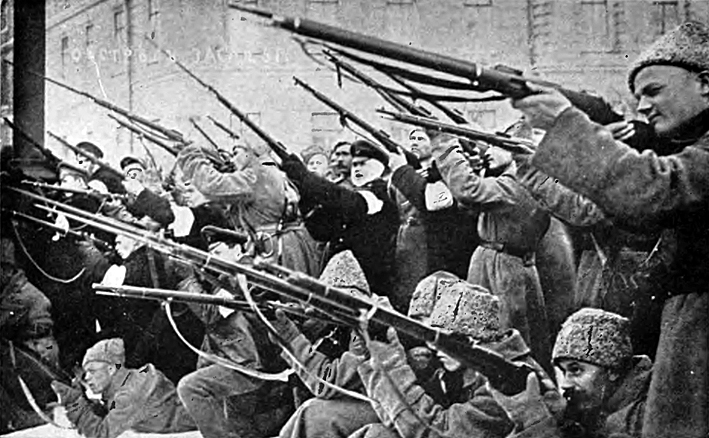
- The beginnings of revolution in Petrograd (St Petersburg) in 1917 [Wikipedia]
The early days of the Russian Revolution - the 1917 February Revolution as opposed to the more well known October Revolution - were revealed in an interview in The Luton News with the brother-in-law of a local businessman who had fled Russia and was hoping to take up permanent residence in Bedfordshire with his Luton-born wife. No names were mentioned in the interview, but the story read:
After residence in Russia through the critical period of the Revolution, and after many trying experiences, the brother-in-law and sister of a well-known local business gentleman have returned to Luton to take up residence here. His father went to Russia 25 years ago, and the gentleman whom we have interviewed was born there and has lived the greater part of his life in Russia.
Until quite recently he was chief engineer at a big factory about 100 miles from Moscow, and resided there with his wife, a Luton lady. He was in England when war broke out and, returning to Russia about the end of October 1914 he found Russia had mobilised in a remarkably short time.
All men had been taken, however, irrespective of their greater usefulness in civil life. The factories were in difficulties, and an industrial crisis was bound to follow. Later on, however, many men returned, but there followed a lot of treachery which was openly spoken of among the masses.
"Our town - a manufacturing one - was worse than Petrograd [St Petersburg] when the Revolution broke out. It started for us by one of the soldiers' delegates arriving, going round the mills and stopping the workers. He got the people to raid the police headquarters and the whole of the force was sent, handcuffed, to Moscow to be imprisoned. They were under the strong guard of a half-drunken mob.
"The revolution was quite undisciplined. A tremendous amount of firing went on, and a large number of people were shot down without questions being asked as to what party they belonged. The disorder continued for a long time, and the workpeople took control of the mills.
"They gave themselves an eight hour day, increased their wages from one to 12 roubles, and the production went down to 55 per cent. I was powerless to do anything.
"As showing the inconsistency of the acts of these people, they raised the wages of the masters and foremen in proportion to their own, and mine were increased to double the amount. Then the people actually seized the foremen, put sacks over their heads, wheeled them out in wheelbarrows and threw them into the river.
"I also was seized, and as the mechanical department in which I was a favourite was too small to prevent it, the factory people wheeled me out for no reason at all and were going to throw me in the river, but at the last moment thought better of it. They let me free when I told them they would have to wheel me in again, as there would be a report to the British Consul. That threat worked then, but I am certain they are past it now and it would have no effect.
"The shell-making had to be stopped owing to the absence of steel and fuel, and in the factory 70 girls and 100 men were thrown out of work. The Workmen's Committee ordered the firm to go on paying them, although they were loitering about. Thus things went on in this chaotic state.
"The peasants have seized the land and till only sufficient for their immediate needs, refusing to let the landowner till any more, and they have broken up the implements on the land, with the result that there is a grave food shortage.
"The deserters from the army stormed the train I was on, and they sat in great numbers on the roof of the carriages. I saw hundreds swept off when we passed under the bridges. On every train and all over it swarm the deserters from the army.
"I felt that I was not helping in the prosecution of the war under such conditions, and my wife and I decided to leave Russia. We started on July 16th, after selling up, and it took us a month to get home. I was a week in Petrograd trying to get special permission to leave from the British Embassy, as the frontier was closed.
"We had a fairly comfortable journey, but were detained in Norway for passports. We had quite a holiday at a nice place called Voss. We got scanty treatment from the Swedes, but the Norwegians were more than friendly."
[The Luton News: Thursday, September 6th, 1917]