

Digest of stories from The Luton News: Thursday, April 4th, 1918.
Luton appears to have led the country in that excellent project, the appointment of Local Advisory Committees under the Ministry of Labour. Inaugurated in a somewhat inconspicuous manner, within a few weeks the scope of its work has broadened extensively, and the enthusiasm of the members justifies the vista of a not distant day when the relations of capital and labour may be so amicable that strikes and lock-outs will be a thing of the past, and no industrious man or woman be without employment or provision in the event of enforced rest.
 It was first mentioned as a small committee of employers and employees, but the committee has found its possibilities enlarged and the number has been increased until it may now be regarded as representative of practically all classes of industry.
The radius of the committee's operation extends beyond South Beds, for it goes to Harpenden, Welwyn and Markyate in Herts, and to Wing and Cheddington in Bucks. The 40 towns and villages it covers include Luton, Dunstable and Leighton Buzzard and all the intermediate villages, and setps are being taken to bring each hamlet and parish into intimate relationship with headquarters.
The principal work of the committee at present is to make arrangements for demobilisation and, almost of equal importance, the question of substitution. An important feature relates to the discharged soldiers who are being called for re-examination and service if they are not in work of national importance.
The committee practically controls the placing of the discharged men. If one has been wounded or served overseas and been discharged, and the military authorities request him to present himself for re-examination at the end of the usual period of 12 months, if he is on work of national importance he is automatically exempt. Those who are so engaged have a month's grace in which to find it, but this Advisory Committee has power to extend the period and help him to secure it.
Not only is the work of placing discharged soldiers of great importance, but the question of displaced female labour will, sooner or later, be a thorny one, and a committee for dealing with women workers is in course of construction.
-
After speaking of the busy state of the straw trade generally, the local correspondent of the Hatters' Gazette says: "Dyers and bleachers are overwhelmed with work; they really do not know what to do!" However, he recorded that the price of bleaching straw plaits had risen, due to labour charges and the cost of chemicals having greatly increased.
-
A considerable portion of Eastertide was not regarded as a holiday in several of the industries of Luton, and a fair amount of work was done in gthe straw trade as well as in the engineering trade. The latter, in a general sense, closed down, only the work of immediate vital importance proceeding.
-
We understand that the well-known pageant Children Through the Centuries, which has already been produced in most of the large towns in England and Wales with phenomenal success, is to be given at Luton on April 10th in the Grand Theatre at 2.30 and at the Town Hall at 7.30 in aid of the War Emergency Fund of the Waifs and Strays Society. The various scenes are being arranged by local residents, who are enlisting the help of no less than 300 local performers. The Society has already provided homes for over 1,900 children of our soldiers and sailors, and a special home for the children of men killed in action has been opened.
-
The Red Cross Band played in Wardown Park on Easter Sunday afternoon, when under the conductorship of Mr William Clarke, a number of selections were well rendered. The proceeds were for the Band Fund.
-
On Bank Holiday Monday, St Peter's Troop of Boy Scouts marched to Berkhamstead, where they were received by the boy scouts there. They had a sing-song and a generally pleasant evening, and slept the night at the headquarters. They marched back on Tuesday, doing the 16 miles in five and a half hours.
-
The wedding took place last week of Frederick Batchelor (R.A.M.C.) and Miss Winifred E. L. Pryor, only daughter of Mr W. W. Pryor, of Breachwood Green Post Office. Mr Batchelor is son of the well-known coal merchant and farmer of Kimpton and King's Walden, and Miss Pryor is Infants' Mistress at Breachwood Green County Council School.
-
"He was killed on March 27th, leading the old battalion into action." The news of the death of Lt-Col John Stanhope Collings Wells DSO was received by his parents at Caddington Hall on Monday in the form of a War Office telegram. Educated at Oxford, Lt-Col Collings Wells had served in the Herts Militia before gaining a commission in the Bedfordshire Regiment in 1905. Following the outbreak of war he went to France with the Bedfords and was wounded in January 1915, returning to the trenches the following March. His gallantry had quickly gained him promotion and earned him the DSO. [He was buried at Bouzincourt Ridge Cemetery, Albert.]
-
Many in Luton will learn with regret of the death in action on March 29th of Lieut-Col Harold Echalaz Welch DSO, for he had many associations with the town. His grandfather Mr Alfred Phippen Welch, of the hat manufacturing firm of Welch & Sons, was donor of the Luton Children's House. He lived at the Cantreyn estate in Shropshire. [He was buried at Bouchoir New British Cemetery, France.]
-
The bitterness of the experience of losing a loved one has been intensified in the family of the late Pte Leonard Maynard, of 16 Melson Street, by an ironic freak of fate which gave rise to hopes of his recovery, only for them to be dashed by a grim official announcement of his death. Pte Maynard (Machine Gun Corps) was married, his wife living at 23 Grove Cottages, Cardiff Grove, Luton.
-
The many friends of Second Lieut John Templar Leader (Army Cyclist Corps) was one of the casualties of the "great defensive," having been wounded badly in the left hand by gunshot. His wife, who resides at 13 Harcourt Street, Luton, received the official notification on Saturday and learned that he was in hospital at Rouen and had since been brought to a Wandsworth military hospital. Lieut Leader, from Essex, has lived in Luton for nine years, and on September 11th, 1915, married Nellie Florence Smith, daughter of Sgt Smith, of the Luton Borough Police Force, at Ceylon Baptist Chapel, Luton.
-
We regret to announce that Lieut Maynard Tomson MC, son of Mr R. S. Tomson, of Bedford House, Luton, has sustained severe gunshot wounds in the back, the news reaching Luton on Sunday night. He was conveyed to hospital at Rouen and is now on his way to England. He was an early volunteer from Luton, joining the Honourable Artillery Company immediately war broke out. He later received a commission in the Royal Engineers.
-
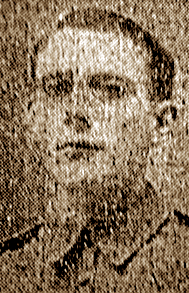 A reassuring cheery letter from Sgt Albert (Bert) Lewzey DCM (Royal Field Artillery) to his sister Ethel at 63 Dumfries Street, Luton, said there was nothing to worry over by the turn of events in France. He wrote: "We all knew it was coming and, so far, it is all to our advantage. What matters the loss of a few miles of barren land? We are not in the dumps here. We say, 'Let them all come'. Can't give us anything worse than we had, and that did not disturb us much, but cost them heavy." [Sgt Lewzey is pictured, right.]
 -
Mrs Ena Jessie Barford, who is living with her parents, Mr and Mrs Cook, at 50 Duke Street, Luton, has received news that her husband Pte Joseph Henry Barford, a Lewis gunner in the Bedfordshire Regiment, has been wounded in the left hand by a gunshot, on the second day of the offensive [March 22nd]. He is now at a convalescent depot at Trouville in France. Before the war he was in the straw trade.
-
Pte Sidney Charles Sinfield (41209, 4th Battalion Bedfordshire Regiment), of 68 High Town Road, Luton, is at present in a Leicester hospital, having been gassed in France. His wife, Rosetta, [married in 1907] is carrying on his greengrocery business in Brunswick Street in his absence.
-
Mr F. W. Budd, of 54 Lea Road, Luton, had received news that his son, L-Cpl Frederick Victor Budd (Royal Munster Fusiliers), has been badly gassed and is now in a Scottish hospital. He originally joined the Connaught Rangers seven years ago and is one of the few Mons heroes now serving.
-
Gunner Percy Ives (Royal Garrison Artillery), who lived with his sister at 125 Wellington Street, Luton, and was formerly a straw hat manufacturer on his own account, has been severely wounded in the right leg and left arm. After receiving the intimation that he was wounded, Miss Ives was informed that her brother's leg had been amputated. He is in hospital in France.
-
Pioneer Percy Wallace Bone, son of Mr William Bone, plumber and decorator, of 135 Wellington Street, Luton, has been severely gassed while serving with the Royal Engineers (166005) in France, and is in hospital at Rouen.
-
Since leaving Luton a year ago for German East Africa, Pte Horace Fensome (A.S.C. Motor Transport), whose wife lives at 1 Tavistock Street, Luton, has had a perilous career. After considerable service in Africa, he contracted malaria and other troubles, and he was invalided home. But his troubles had not ended, for he was on board the Guildford Castle which was torpedoed off the English coast. He stood for hours in the cold, with little clothing on, until he could be taken off the sinking ship. We are pleased to know he landed safely at Netley Hospital, and that he is going on as well as can be expected.
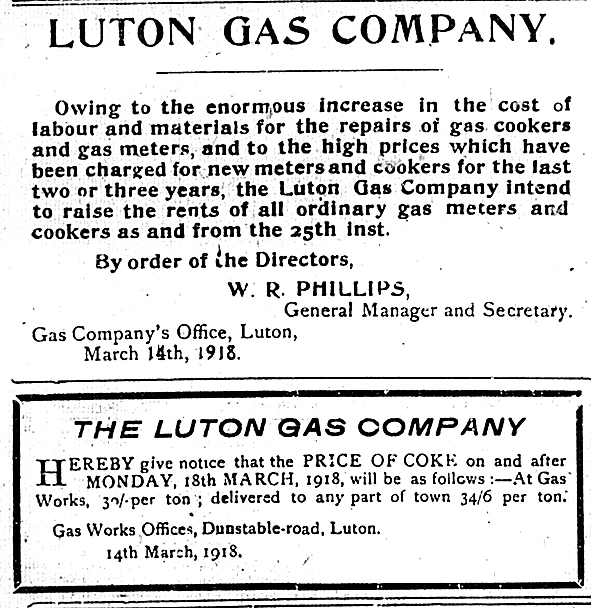 Advert