

We wish we could be sure that the hundreds of people now daily to be seen standing in the queues outside margarine and provision shops had it honour bound themselves to observe the voluntary rationing scheme put forward by the Director of Food Economy. On all hands one hears suggestions that people are using the queues to secure more than their fair share of the necessaries available.
We know very little of what the Luton Food Committee are doing. We know that they have passed a resolution expressing their conviction that compulsory rationing should be imposed, but we have yet to learn that they have done anything to encourage the people to practice economy in food or to promote [Director of Food Economy] Sir Arthur Yapp's scheme of voluntary rations.
We have heard it said that it is not the business of the Food Committee to promote food economy - that is a matter in which the Mayor should take a lead. Well, what is anybody's business is nobody's business! The expression of the pious opinion that compulsory rationing is necessary does not relieve the town of its responsibility.
Lord Rhondda [Government Food Controller] has stated: "It depends upon how the public respond during the next few weeks to the appeal that has been made for voluntary rationing. If that campaign does not succeed, compulsory rationing will be necessary."
In the absence of initiative by the local Food Committee we welcome the signs of activity among the local churches on the subject. At several places of worship last Sunday, pulpit references were made to the responsibility of the individual, and congregations were exhorted to sign cards to be found in the pews and the to keep the pledge made to rigidly adhere to the scales of voluntary rationing outlined by Sir Arthur Yapp.
In this connection it may be interesting to set out the weekly voluntary rationing scale of the League of National Safety. The scale for adults is as follows:
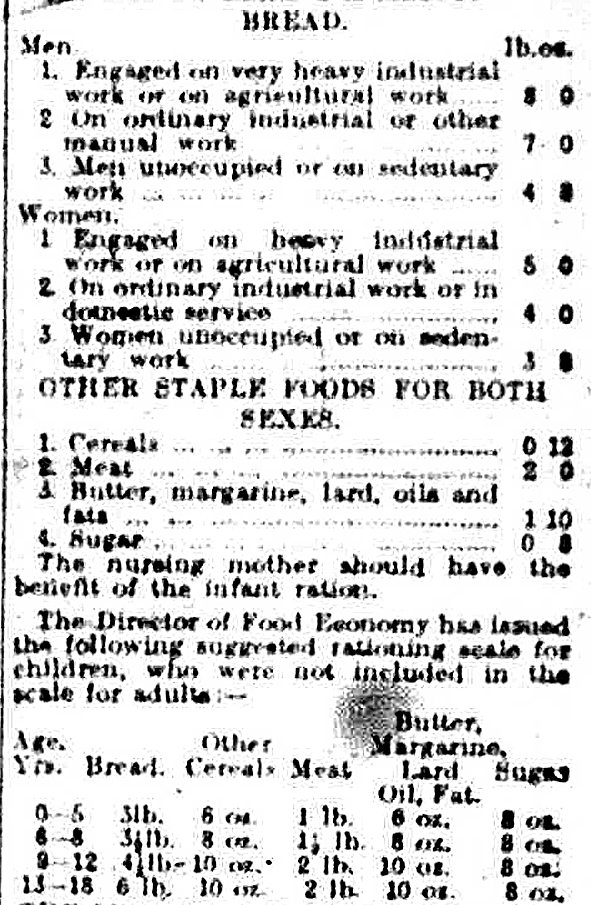
Arrangements are in preparation for an 'Anchor Week' in the first week of the New Year, when a great effort will be made to complete the enrolment of 10 million members of the League of National Safety. Meantime, Sir Arthur Yapp has written a letter which is published in the 'National Food Journal' in which he emphasises the urgency of the position, and asks people to sign the declaration at once and get to work enrolling others as members.
He adds: "The fact cannot be too strongly emphasised that the League of National Safety may be the means of saving the country from the expense and vexation of compulsory rationing by tickets."
At the present time London easily heads the list on the membership roll of the League with three times as many members as Surrey, which comes second. Then follow Yorkshire, Lancashire, Middlesex, Sussex and Kent in the order named. Other counties have yet to be roused to more vigorous action.
The League seeks to enrol every adult man or woman in the United Kingdom, thereby creating a vast national organisation of patriotic citizens pledge to economise in food and check all forms of waste.
Some of the local grocers have sent out the sugar cards this week, and householders should deal with them at once.
On the first scheme of sugar cards local committees secured very valuable information as to the number of people to be catered for, and under the new system the supplier will be put into full possession of the details of the number of mouths in every family.
Under such circumstances it should not be as very difficult to ration people for butter, margarine, lard etc, if there was the guarantee that the retailer would be given the needful quantities to meet the fair demands upon him.
The greatest difficulty at the moment, however, appears to be the unequal distribution, and while certain stores can get hold of big supplies it would appear to be impossible to put a stop to the scandal of the queues.
We wonder if the local committee has made any representation to headquarters that it is time he Government commandeered the supplies and made itself responsible for a fair and equitable distribution.
Butchers are complaining that high prices obtaining in the markets are making it impossible for them to trade at a profit. But Food Committees must not allow them to jump up prices just because round about the Christmas Fat Stock Sales competition for prime beasts result in a few individual record prices. Rather should the efforts of committees be devoted to bringing pressure to bear in the proper quarter to have the live weight buying price of cattle and sheep fixed. It is indeed somewhat difficult to understand why this has not already been done.
The 'Beds Times' this week has some comments on the subject of meat trade difficulties, and it observes that local Food Committees are obviously "in a position to know the facts of the situation, because a periodical return has to be made to the Committee by every butcher, showing the cost and selling price of his meat, so that there may be a check upon his profits, which are not to exceed 2d per lb or 20 per cent, whichever is the larger. It seems to us that am examination of these returns is a much fairer way of judging the position than the working out of the figures in an isolated case.
"As for the high market prices of cattle, the remedy is surely in the hands of the butchers. If the prices are going up and up, it must be cause the butchers who buy are offering higher and higher prices."
[Beds & Herts Saturday Telegraph: December 15th, 1917]