

[From The Luton News: Thursday, November 15th, 1917]
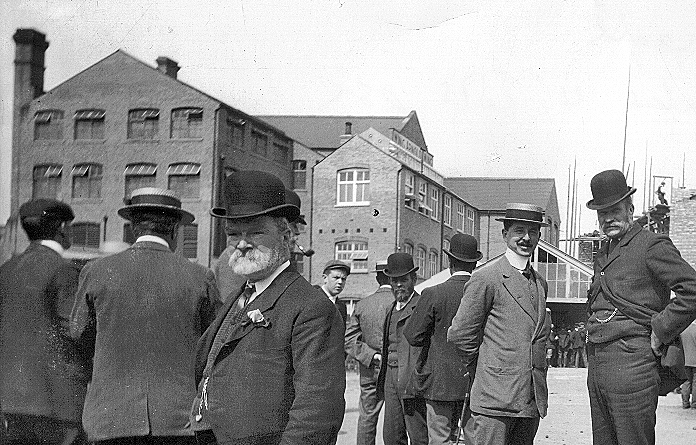
- The Wing, Arnold, Wing factory seen from the adjacent cattle market in 1907
Two fires of such magnitude as that of Messrs Brown & Green's on Tuesday and the demolition of the straw hat factory of Messrs Wing, Arnold and Wing this morning may aptly be described as a dual disaster. Within 36 hours two important works have been reduced by fire, one by half and the other to absolute ruin.
The hat factory is gutted. From basement to roof, backwards and forwards, the fire made its way, and, although the scene was not as picturesque as that of Tuesday night since the flare of fire is less obvious in daylight than darkness, it was sufficient to give the large crowd of spectators an idea of the extent of the disaster.
By 10.30 am nothing more than the shell of the building remained, and in spite of all the efforts of the firemen the place is a total loss - the first, by the way, since Chief Officer Andrew came to Luton.
The outbreak was notified at 8.20 this morning, having apparently broken out in a back room. In a very few minutes huge tongues of flame were bursting from the roofs.
The Brigade were quickly on the scene, and on arrival were faced with what appeared to be a despairing task. Already huge sheets of flame rose from the rear of the building, and the smart breeze gently fanning the fire drove it towards the front of the building. The motor engine was got to work near the Manchester Street end of Bridge Street, three jets being directed from the rear and two from the front. Water was extracted from the River Lea and nearby hydrants.
Three floors, it was at once apparent, were hopelessly involved. The enormous quantity of highly inflammable material with which the warehouse and plait rooms were stocked provided an abundance of fuel, and in spite of all efforts on the part of the Brigade, flames gradually crept through the whole of the ceilings in the front block. From the majority of the 20-odd windows on this side, at one period, came sheets of flame and dense clouds of smoke.
Before nine o'clock the top of the building fell in with a crash, and it was followed at intervals by the fifth and fourth floors.
How rapidly the flames spread between half-past eight and nine o'clock was shown by the fact that the roof supports were a charred and twisted entanglement, machinery had dropped from one floor to another and the facade, a dual culmination of the front elevation, fell in two great swoops into Bridge Street, between the two parties of firemen.
Efforts had been directed, as far as possible, to the saving of the immense quantities of stock in the lower floors in the main building, but by way of the lift, visible from the street, wave after wave of fire rolled into this department and persistently defied the powerful streams of water.
By half-past nine the place was a cauldron-furnace. The firemen on arrival had promptly entered the building from the rear, but great gusts of flame swept towards them in irresistible fashion, and Chief Office Andrew had no option but to withdraw his forces to a safer and more useful coign of vantage.
Before 11 o'clock there were only spasmodic bursts of flame, little clouds of steam, smouldering spars and a heap of ruins to be seen.
The Brigade's work was done, and although little of Messrs Wing, Arnold and Wing's factory remains, without doubt they saved the adjoining buildings.
The premises of the firm are situated in Guildford Street and extend from the Great Northern Railway bridge for a distance of about 20 yards. The building is quite a modern one of five storeys, and was fronted by a high facade. It runs back to the river abutting on Messrs J. Cumberland & Sons' Cattle Mart. In close proximity are the factories of Mrs G. L. Hart and G. Field and the timber yard of Alderman H. O. Williams.
Though hardly a picturesque erection from an architectural point of view, the building was thoroughly serviceable for the purposes for which it was erected.
The factory was packed with material, much of which was already made up in readiness for the spring trade. Thousands of orders were in hand to cater both for the home and export business. The firm employed about 100 hands.
It is impossible to give an approximate estimate of the damage. The firm has flourished exceedingly from its inception, but never so rapidly as during the past five years, and today they had thousands of pounds worth of orders in hand, many completed and awaiting dispatch.
The firm is engaged both in manufacture and in the retail business, and does a tremendous business. Two of the partners were on the scene by nine o'clock, but they could do nothing but watch the efforts of the firemen.
The firm have lost no time in an effort to retrieve the situation, for premises have been secured this morning in King Street and Collingdon Street, and work will be resumed immediately.
P.Sgt Matsell was on the spot almost simultaneously with the Fire Brigade. Other members of the regular and special constabulary were quickly in attendance and rendered valuable assistance.
The Luton Reporter newspaper of November 20th said the total damage was estimated at from £30,000 to £35,000, a value of £15,000 being placed upon the building which was erected by Mr Edward How some 12 years previously.
The outbreak was discovered by a lad named Frederick Bland, of 98a Park Street, when he went up to one of the top rooms to fetch materials with which to start his customary sweeping up and cleaning work. He was beaten back by the smoke and left the building. He was finally able to call the Fire Brigade from the Midland Railway Station. It was one of two calls received by the Brigade about the fire and they were on the scene within three minutes.