

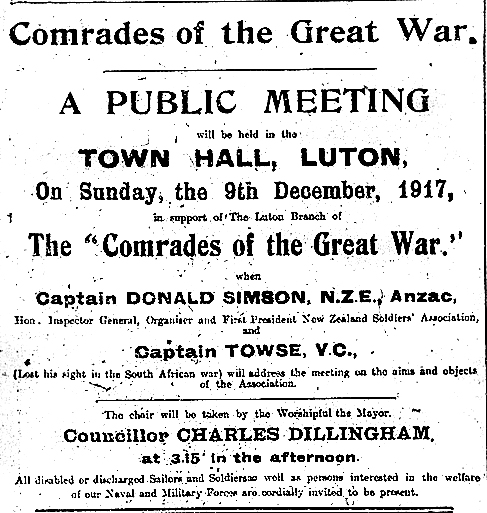
The inauguration in Luton of a branch of the recently formed Comrades of the Great War movement is to be supported at a public meeting to be held at the Town Hall under the chairmanship of the Mayor (Councillor Charles Dillingham) next Sunday afternoon. This development very naturally formed the topic of discussion at the monthly meeting of the Luton and District Discharged Sailors and Soldiers Association, held at the Franklin Restaurant under the chairmanship of Mr Herbert W. Booth on Friday night.
It was reported that the DS&S Executive Committee decided at their meeting on November 17th to approach the Mayor with the object of enlisting his sympathy and support. A deputation consisting of the Chairman, Hon Secretary and Mr Suttle accordingly waited on Councillor Dillingham the previous Friday. Having stated the object of their visit they were informed by the Mayor that he had promised to preside at a meeting organised by the Comrades of the Great War whom, he was told, claimed to have 100 members in the town.
The deputation told the Mayor they had no knowledge of the existence of a local branch of this organisation and, in any case, the Federation was a body that was first in the field and was doing the work which the Comrades of the Great War proposed to do in practically the same way.
Under the circumstances, however, it was felt after further discussion that the time was not opportune for pressing the claims of the Association as the Mayor, having given his promise to preside at the Comrades of the Great War meeting, could not be expected to withdraw his support.
In the course of the discussion on the matter with the Mayor, reference was made to the meeting held at the Mansion House on November 14th and the fact that the Lord Mayor of London and Lord Charles Beresford had apologised for statements made there with regard to the National Federation of Discharged and Demobilised Sailors and Soldiers. The deputation assured the Mayor that they had previously considered their attitude with regard to the Comrades of the Great War and it had been decided to recommend that on no account should there be any interruption of the proposed meeting.
The Executive Committee could not recollect that the Association had evinced any hostility towards the Comrades of the Great War movement, except that at an open public meeting for discharged men a resolution was unanimously passed that there was no necessity for the new organisation and they were prepared, if the Comrades of the Great War would meet them openly and in public under an impartial chairman, to debate the points on which they differed.
Mr Freestone, an organiser of the Comrades of the Great War, was given an opportunity to state to the meeting the case for that organisation and, in an address of considerable length, intimated that his organisation would guarantee a public meeting for the discussion of differences as suggested.
The Chairman and Mr W. J. Mabley followed up with statements setting out the Association's attitude towards the new movement, the organiser being informed that until the points raised by Mr Hogge MP in a public statement made in reply to the Mansion House meeting there was not too much prospect of agreement between the two.
The membership of the Association was reported to be well over 100 and in view of the large increase the Executive invited the members to elect a more representative body or, if they chose, charge the personnel. It was however agreed that the existing Executive should continue to serve with the exception that Mr W. L. Suttle was elected Hon Secretary in place of Mr Walker, who expressed a wish to resign.
[The Luton Reporter: Tuesday, December 4th, 1917]