

The news that Cpl Sydney Eads, a Lutonian with the Australians, son of Mr William John Richardson Eads and his wife Minnie Beatrice, of 24 Rothesay Road and Dunstable Road, Luton, has been released from captivity has been a source of great relief to his relatives. They live in the hope from day to day that he will soon be back home amongst them.
He was captured in the big push of July 1916, and since then had been a prisoner of war in Germany. He has been interned in Holland since June this year. He is now at The Hague, and writes very favourably of the district and the treatment he is now receiving.
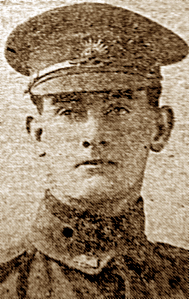 Regarding his experiences in Germany, in one letter just to hand Cpl Eads [pictured] writes: “I can hardly describe my feelings now that I out of that cursed man's country way back – the hell hole of the world. The atrocities of the Congo pale into insignificance when compared with some of the things that have just happened in Germany.
“If prisoners were to tell all that has happened there recently it would not be believed by many... We used to take a delight in beating the square heads whenever we could. Sometimes we would succeed and, worse luck, sometimes we would fail, and then we paid for it.
“I well remember that for three weeks 500-odd NCOs lived on a 'soup' made of absolutely rotten swedes and nothing else, because we would not work, as our parcels were not given to us. In the end 15 men were sent to push a waggon 15 kilometres to fetch our parcels. The snow at the time was in places lying 2 feet deep. What beat the Huns most of all was that one could still raise a smile and say 'nix arbeit' ['Nothing work'].
“The rest will keep until I see you. I'll tell you then how they got the thin veneer of civilisation off us and made us into what man was in primitive times and wild dogs are to this day. Remind me of the camp at Dulmen and the first white bread I saw there and you will hear something. Remember me to all friends who enquire.”
If anyone questions the advisability of the endeavour now being made in Luton in aid of the Prisoners of War Fund, we think the above extract should dissipate all doubts.
On arriving at his family home at 24 Rothesay Road, Luton, following repatriation via Hull on November 18th, Sydney gave an interview to the Luton News (November 28th, 1918). He said the five months he had spent in Holland were not bad and, although the Dutch were shot of everything, including food, they could not grumble.
During the whole of his time there he was an instructor at the British Red Cross and Autocar school of motor mechanics at the Hague. He had photographs of British prisoners of war and their guards, and of the motor car works in Holland and the work produced there.
Cpl Eads had been in an NCO camp. By agreement between the British and German Governments NCOs were not to be compulsorily employed on certain work. Their captors, however, sought by all the most cruel and inhuman means at their disposal to torment them to such an extent that their spirit should be broken, and they would then volunteer to do the common work. In this they did not succeed, and the Englishman's spirit could never be broken.
He had been on parade when they had to stand to attention for hours at a time, in rain or snow. He had watched strong men, overcome by the exposure and the strain, fall one by one in a dead faint, until they lay on the soaking ground by the dozen or score. He had watched without moving a muscle, for if anyone had stirred a limb, let alone stooped down to help a fallen comrade, they would immediately, by the instrumenality of the butt of a rifle, have been reduced to a worse state than those who had fainted. Life was held very lightly, and it was death to the man who disobeyed an order.
The food was insufficient and very bad, dinner invariably being 'swede soup' – hot water containing lumps of swede. “I well remember the first piece of white bread I saw in Germany,” he said. “I was lying unable to stand on my legs, against a dirty bin, and another fellow came up and threw a lump of half mouldy white bread in. As quickly as man ever moved I was up and spread-eagled across the bin, with the precious food in my hands. But not too soon, for already half a dozen other chaps came tearing up to get it.”
He confessed that he was reduced to such a state that he would have killed any one of them for it. He ate it, eventually, and very ill it made him, though he would have eaten more had it been obtainable. The bread of which they ordinarily fed was much inferior to that which the civilian Germans had, its chief ingredient being heather which was cut up and made into 'bread' by Russian prisoners. They could sometime pull whole stalks or heads of the plant out of it.
[The Luton News: Thursday, July 18th, 1918, and November 28th, 1918.]
[Sydney Eads was born in Bendish, Herts, on September 11th, 1886, and in 1901 was living with parents William and Minnie in Park Street, Luton. He worked at Hayward Tyler as an engineer and joined the Bedfordshire Volunteers. In January 1908 he emigrated to Australia and in 1912 married Isabell. They lived in Annandale, Sydney, New South Wales, and had a daughter, Grace Beatrice Minnie, who was born in May 1914.
Sydney joined the 55th Australian Imperial Force (3086) in August 1915 and was sent abroad the following December, serving first in Egypt. In June 1916 he sailed from Alexandria to join the British Expeditionary Force, and was reported missing at Levantie in France on July 20th, 1916, and then a prisoner of war at camps including Dulmen and Soltau.
He was transferred to Holland on June 13th, 1918, but did not get to England until November 18th. He returned to Australia on April 18th, 1919, and arrived in Melbourne on March 4th. He was discharged in Sydney in April 1919. Sadly he died in Sydney on December 2nd, 1920, and is buried at Waverley Cemetery in New South Wales.
Sydney's younger brother, Richard Cyril (69348, 6th Battalion Queen's (Royal West Surrey) Regiment, was killed in action in France on August 18th, 1918, aged 18. He was buried at Daours Communal Cemetery Extension and commemorated on the Luton Roll of Honour/War Memorial.]