

The Luton News of December 19, 1918, recorded “a murder as foul as any that has stained the dark pages of this war”. The victim was Pioneer James Baxter, a prisoner of war whose home was in Great Northern Road, Dunstable.
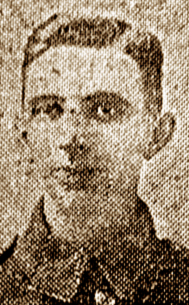 Pioneer Baxter (pictured) had joined up in the Royal Engineers at Bedford in August 1917, and after three months' training proceeded to France. He was captured by the Germans on March 21, 1918, and was subsequently interned in camps at Parchim and Wesel.
The news of his fate was first conveyed to his wife Elsie in a letter from a chum, Pte A. Bungay. He wrote that her husband had been “cruelly done to death” by a brutal German guard.
In a second letter, Pte Bungay – who was by then in Dorset after the war – wrote: “I will let you know all I can about your husband, as he was a very nice chap and we all respected him. I was a prisoner myself, captured on March 21 with Mr Baxter.
“One day we were picking up leaves for he Germans and, while going up the bank to start work, the guard went after Mr Baxter and nearly murdered him with the butt of his rifle, and then shot him straight through the back.
“I then went to his assistance and the guard having gone I put him in a better position, but he died soon after. I and two other pals got him down to the bottom of he bank and took him away, and buried him two days after.
“My pals and I had dug his grave in a cemetery in the village. When we buried him there was a German priest present and the rest of the boys.”
The Royal Engineers Records Office were reported to have taken the matter up very strongly and were making strenuous efforts to collect all the evidence of the brutal crime.
[Commonwealth War Graves Commission records show that Scottish-born Pioneer James Baxter, 316963, J Special Company Royal Engineers, was killed on September 26, 1918, at the age of 32. His remains are now interred at Niederzwehren Cemetery, Kassel, Germany.]