

Edward James Catling served throughout the First World War from start to finish. He was wounded at Ypres and suffered bouts of rheumatism which he attributed to his work in burying the dead as Royal Army Medical Corps private 2181.
Born in Finsbury Park, London, on July 2nd, 1891, he moved with his family to Luton while he was still young and lived here until he was aged 17, when in 1908 he chose a military career.
His father, Edward, was a platelayer with the Great Northern Railway. He and wife Frances Mary and six other children (four daughter and two sons) were living at 53 Langley Street, Luton, in 1911 before moving to 24a Queen Street.
After a brief spell back in civilian life, Edward James re-enlisted at the start of the war. By October 1916 he had seen service in Flanders, Gallipoli and Mesopotamia. This was his story up to that point as told in the following article from The Luton News of October 19th, 1916, when he was in hospital in Mesopotamia.
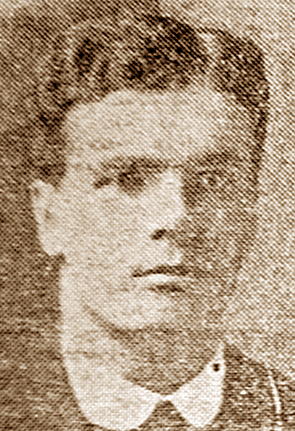 Pte E. J. Catling (pictured), of the R.A.M.C., whose home is at 24a Queen Street, Luton, has had a full share of experiences since the outbreak of war.
Early displaying a partiality for military life, at the age of 17 he joined the Militia. After completing his term of service, he returned to civilian duties and worked for hat manufacturer Mr William Skinner, of 148 Park Street, for some time, and later at the Humber Works, Coventry.
Shortly after war broke out, however, he again joined the Colours. He was sent to France at an early stage, and in November 1914, at Ypres, he was wounded in the ankle by shrapnel.
Recovering, he sailed for Egypt in March 1915 and was in that first fateful landing at the Dardanelles on April 25th, 1915, with the 29th Division. He was invalided to England at the end of August in the same year with rheumatic fever, and sailed again in January 1916 for Mesopotamia.
A recent letter to his mother from the 23rd Stationary Hospital in Mesopotamia says: "It is still terribly hot out here, and just now we are pestered with sand flies, which are so small you can hardly see them, but they can bite and get through the small holes of our mosquito curtains and make us very uncomfortable nearly the whole of the night."
He is still keeping in good health, though a number of his comrades are less fortunate. He had not met with any Luton men out there yet.
Pte Catling was an old member of the Luton Trinity Football Club,and says he can boot a ball as well as ever with the foot in which he was wounded. On Whit Tuesday, 1914, he won the 200 yards scratch race at the Luton Harriers sports meeting.
Edward James Catling returned from Mesopotamia in April 1919 and was demobilised in November 1919. He married Olive May Tysom in Luton in 1921, and died in Elstree in 1965 at the age of 74.