

Early action near Ypres had been fought 18 months earlier but on March 13th, 1916, the Luton Reporter printed an article "specially contributed by an officer" of the 1st Bedfords recalling the regiment's stand on September 7th, 1914. He wrote:
It was nearing ten o'clock on a beautiful Sunday morning. The air was frosty, the sky clear and blue. An autumn sun had just made to disappear the the grey mist that had for some days been overhanging the trenches, which lay on a summit and down the side of a slight ravine of the great ridge whereon, defiantly, the thin British line face the far superior forces of the Boche.
 In the centre of the line 'A' Company was holding, with half 'C' Company in support and a few yards to the rear, lay the Company Commander's dug-out, just out of sight of the left half of the trench that ran above on the level of the hill and from where the right half ran away down the gentle slope of the ravine.
The trench - there was only the front line dug - was cut just clear of a wood of tall, thin spruce trees. Below, in the wood at the foot of the hill, lay the rest of the battalion (who had arrived the night before from in front of La Bassée in motor buses) in support dug-outs.
An occasional bullet cracked furtively here and there, and occasional rifle shot rang out in response, an occasional bird in the wood broke into song.
Suddenly, like the crack of doom, there broke out a most terrific roar of rifle fire from the enemy trenches some hundred yards away. Shells whistled plaintively and menacingly overhead. The air seemed one mass of cracking bullets - as if, almost, a crowd of cowboys were round, cracking their whips like mad.
For some ten minutes it lasted and then, to his utter horror, the Company Commander in his dug-out became aware of men straggling past its entrance to the rear with rifles and packs slung on their shoulders. "Regiment on our left has retired and the Germans coming over in swarms," one man shouted to him, "and they are all round our left."
These men had mostly only joined a few days previously and this was their first experience of fire, and there had been no officer available for that particular piece of trench. They were met by a party of 'C' Company and eventually rallied and rushed back to the right trench, which in the absence of the Company Commander who was helping to rally the others, had also partially retired from the trench, just in time to stop and finish off a party of Boches who were seizing the opportunity to get across on the right.
Presently word came down the line that the Germans over the hill were getting right round the flank. The line of trench now held lay in immediate peril, so it seemed, of being taken in the rear. The order was given to fall back on to the high ground 50 yards inside the wood.
The bullets were still coming over in sheets at point-blank range, but the line got back, only to find that Major Allason with a party of 'C' Company was holding a knoll a bit to the left. Drawn by what they thought was a retirement, these men, too, began to fall back, but the line was successfully halted in position and swung to the left. Here for a while bullets were coming from all directions, and here it was that Major Allason, helping to rally the men, was wounded for the first time in the shoulder. He received another later in the day, when reconnoitring the situation on the left for the General, and was then only prevented from rejoining the fight by force.
It was found that the new position was too exposed, and so again the line advanced afresh to the old line of trenches, covered again by the knoll and made now secure by what was happening meanwhile on the left over the top of the hill.
Here it was that the Germans, having broken though some 400 yards of trench, were swarming down upon the support dug-outs, where the only officers with this half of the battalion - Colonel Griffith, Major Monteith, Capt Macready and Lieut Davenport - were seated in a large open dug-out. The whole affair had been of such rapidity that the first intimation of anything wrong came to them through a few men from the top of the hill that the Boches were on them.
There was just time to collect the two companies, scattered about amongst the dug-outs, whilst Capt Macready with a small party of men on the left and CQMS Byford on the right with another that they quickly collected, charged the foremost Germans, who were now halfway down the hill. It was here that the former, severely wounded almost at once, gained the D.S.O., and the latter the D.C.M., capturing some 30 prisoners alone. The remainder of the men of 'B' and 'D' Companies charged up the hill and retook it as far as the crest, but the enemy holding the captured trench made any further advance impossible.
Capt Weatherby, of the 52nd Light Infantry, our Brigade-Major, told me the following day in his own words: "It was grand! At first we thought we were going to waver, but suddenly a cheer was raised from the left and next moment they were all streaking up the hill like a pack of hounds."
And now for a while the rain of bullets dwindled down into a steady drizzle. The gap was filled and the line once more secured. Again on the right the fire broke out with renewed violence. It seemed that another attack was impending. There were no more supports available. The line raised cheer after cheer and redoubled their fire, and the Boches stayed where they were.
Colonel Griffith appeared here on the right about this time, and I was able to report that we were secure. I then went on to the left to find out to what extent we were in touch, as, in the close growth, it was impossible to see anything. Time after time one was forced lie flat and pray to all one's gods,as the fie broke out afresh, slowly to die away again.
I eventually found 'D' Company busily digging in on the extreme left, and they reported being in touch with the regiment on their left. Numerous wounded Germans were making the air hideous with their shouts, many other lying dead. I had a short conversation with a Bavarian officer, badly wounded in the thigh, who had been kind enough to replace with his my pistol that had tumbled out of my holster earlier in the proceedings and had been lost.
At about 6pm I was told that the lost trench must be recaptured - and was allotted the task of arranging the stunt. Two companies of the Lincolns were to charge with us on the left of our jumbled up line, but it was not until 8.30pm that everything was ready for a move.
It was finally decided to move forward at 9pm, and watches were accordingly set. At a few minutes to nine the men, lying just below the crest of the hill and thoroughly done after the all-day's fighting, were quietly aroused. An indiscriminate fire was coming all the time from the trench in front. The Boches knew as well as we did that an attempt to retake it would be made.
Nine o'clock struck and ended that horrible moment or two before an attack which may be one's last, and the line rose like a lot of vague shadows in the dark and moved forward. Almost instantaneously the enemy opened a withering fire from the trench, that must have been packed a man a foot. It was like running into a great long unbroken streak of fire, and the c racking of the bullets was positively deafening.
Against such metal the line did not get far. The distance to be crossed was only some 80 yards, but they never stood a chance. Personally, I got about 30 yards, and after a kindly bullet had playfully raised a blister across the palm of my hand and another had investigated the lining of my coat, finding myself alone I lay down and wondered if every moment would be my last.
Eventually an orderly managed to reach me - a very brave man, but whose name I do now know - from Lieut Gledstanes (since died of wounds) to say that he, too, had been hung up, and I gave the order for what was left to fall back to just below the crest of the hill and dig in.
This these tired and worn-out men did with a steadiness that is a lasting credit to them, and by dawn a line of trenches had been cut from which they were never again driven, in spite of two furious attacks by the Prussian Guard two or three days later.
I should mention here the pluck and devotion of a subaltern (whose name I cannot remember) and a few sappers from Major Singer's Field Company of Royal Engineers, who effectually wired the trees at a point where the two lines ran within 40 yards of each other.
The casualties that day were seven officers and over 300 men.
It was not until a fortnight later, after further severe shelling, the two other attacks I have already mentioned, and intermittent fighting daily, that the gallant remnant, dishevelled, bearded and utterly worn out - though still unbeaten - were relieved by the French, after suffering untold privations and misery from rain, snow and mud, and reduced to five officers and some 360 men, after having relieved their sister battalion, the 2nd Bedfords, then reduced to two officers and 200 men, at full strength and with 15 officers.
Thus did those gallant fellows uphold the honour and traditions of the Bedfordshire Regiment.
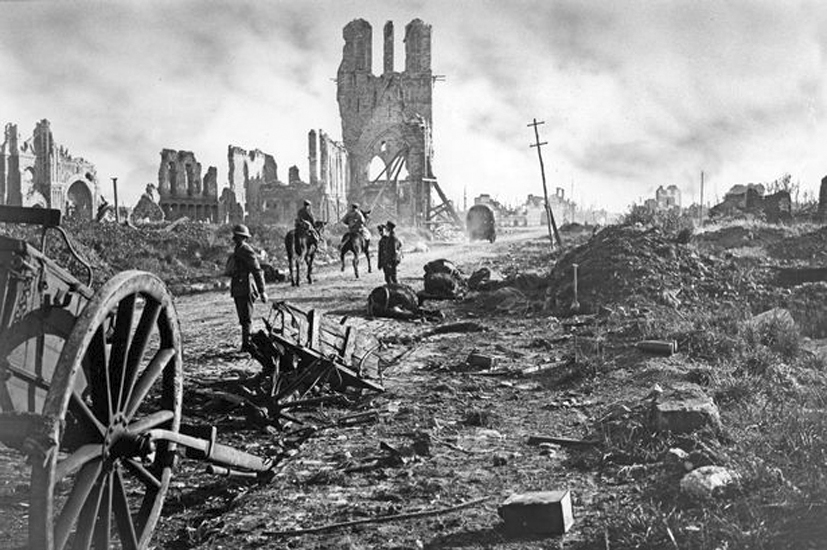
The illustration shows the devastation that eventually befell Ypres.