

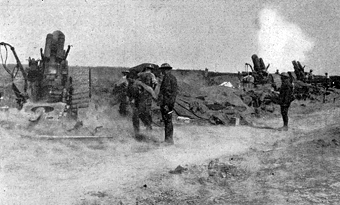
- Artillery barrage near Messines [Canadian official photo published in The Sphere, June 1917]
A graphic account of the Battle of Messines comes from Gunner Sidney R. Bailey, R.F.A., son of Mr Frank Bailey, of 17 Crawley Road, Luton. In a letter to his parents he says:
"No doubt you will have read of the great British offensive. That is where out battery has been in action. Our artillery has been pounding away at the enemy for some days past, and whilst so engaged last Saturday I received a bit of a shaking. Since then the boys have been keeping it up every day.
"There never has been so much artillery in such a space since the commencement of the war, so you can judge the din and noise we have been having night and day.
"The infantry 'went over' at 3.15 this morning just as dawn was breaking. At this hospital (1st New Zealand Field Ambulance) practically all the R.A.M.C. men had to go up to the trenches as stretcher bearers, consequently they were left very short-handed on the staff. They asked for volunteers from us who were able to give a hand, and another fellow and I took on the job of night cooks.
"We started at six last Wednesday evening and the doctor told us to expect a large number of patients in the early hours, telling us the time the infantry were timed to go over the top. We kept plenty of hot water boiling for the wounded lads when they should arrive. We did not have many in during our first spell, but the medical officers kept looking in.
"The Captain came in just before midnight and said he felt hungry. We cut some potatoes and made him some chips. I shall always see him sitting on a little wooden box with his plate of chips on his knee, tucking into them like a little schoolboy and chatting to us."
Gunner Bailey's letter went on: "Our aeroplanes were busy all night, backwards and forwards with messages and wireless signals. About 2.45 am we felt a bit curious, so, stocking up our boilers,we went out into the road. It was still dark, the aeroplanes using their lights, which they switched on and off from time to time.
"The minutes crept on and the darkness was rapidly fleeing. Above us we could see some dark specks in the sky which proved to be our captive balloons already in position, to observe from the very beginning. Scarcely had my watch indicated the hour when a tremendous thunder of guns burst forth.
"Simultaneously a vivid red flash lit up the heavens whilst the ground shivered like a table jelly under our feet. It was the great mine of which we have heard so much. blowing to atoms what would have been a veritable hornets' nest of machine guns and similar death traps for our gallant infantry.
"The cannonade did not last so long as we had imagined. In fact, by four o'clock things were very quiet, and we almost wondered after all if the actual blow had not been struck. We returned to our duties speculating what was taking place just over the hill.
"Some little while elapsed and we heard the jar of the brakes on a motor ambulance. Stepping out we saw the Red Cross men assisting the first batch of heroes from the vehicle. A middle-aged Colonel, his foot swathed in bandages, was struggling with his kit as he hobbled to the receiving room. Giving him a hand, I enquired what luck the boys had. 'We've taken M-----,' he replied with such an air that it might have been a foregone conclusion. Soon others arrived, assuring us that they had 'walked over Fritz' and expressing the opinion that we could hold all we had conquered.
"Just imagine how these war-worn Tommies relished our cup of cocoa. Truly thankful they were, and those who were too shaken to voice thanks beamed with gratitude. It made one feel glad that one could do even a little for those who had undergone so much."
[Beds & Herts Saturday Telegraph: June 23rd, 1917]