

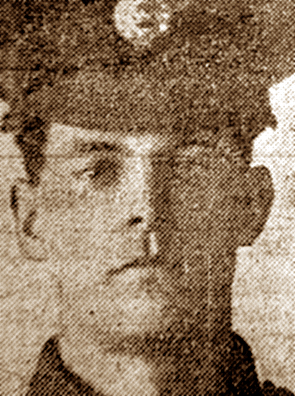
Former Luton Post Office telegraphist Sapper Henry Bennett, 149115, Motor Airline Service [communications] Royal Engineers, was in East Africa in 1916-17. He had joined up in January 1916. His wife Daisy and young son Daniel Henry (born November 30th, 1914) lived at 78 Russell Rise, Luton. Henry (pictured below) had worked at the Post Office since 1906 and had married Daisy at the Ebenezer Baptist Church, Luton, on March 11th, 1912.
In a letter to his wife, he said that news of the East African campaign seemed scarce in Luton, so he wanted to give her an idea of his experiences out there. He wrote:
"Arriving at Mombasa last June, I was quickly sent up to Neutnoshi, which as at that time the Headquarters of the R.E.’s Signals. A couple of days in a rest camp here which, being situated on the hillside close to a splendid water supply, together with liberal rations, and an occasional fine view of the snow clad top of Kilimanjaro, the highest point in Africa, led me to imagine that I was in for a good time.
"Volunteers were called for to proceed to various points, and as I was anxious to get up as far as possible with a view to seeing as much of the country as possible, and also to be near the actual scene of operations, I was able to get a place on a draft for General Van De Venter’s division, then at Kondoa Irangi. I had no idea where this place was, and at that time cared still less, but was not long in discovering I had a motor trip of nearly 300 miles in front of me.
 "This may not appear any great hardship, but it proved no ‘joy ride’. The vehicles were transport lorries, and we were carried as extra weight rather than as passengers. The road was simply a rough track through the bush or desert. The passengers on these cars were frequently obliged to dismount and help push through sand drifts, whilst at other times they were enveloped in a cloud of dust which caused difficulty in breathing.
"One portion of the track lay through a long fly belt. No animal could pass this way and, owing to their absence, the tetse flies took full revenge on the unfortunate travellers. During this trip I went without a wash for three days, water being so scarce.
"I did not reach Kondoa, as I received orders to remain at an office 12miles previous to that place. This proved a lonely dump some 6,000ft above the sea level, where the nights were as cold as the days were hot. It will not be difficult to imagine that with lines of communication as I have briefly described, the rations could not be on a very large scale, and I soon found it was rather difficult to covert something less than one pound of flour without the use of baking powder or fat, items which were unobtainable, into a satisfying day's rations.
"This state of affairs continued for six weeks, and I was then ordered to Kondoa with instructions to walk if other means of transport were not available. The latter proved the case, and I set off with one native boy to carry part of my kit, and had a hard struggle through the sand toreach my destination before dark.
"The Germans have laid out something of a small town at Kondoa, and it was a treat to see a building again, although the telegraphic headquarters were housed under canvas. On one stretch of our line, giraffes were very troublesome, and frequently carried a mile or so of wires away into the bush, and after such periods we had to indulge in good hard ‘slogs’ in order to bring our work up to date.
"Having spent three weeks in this place, where mosquitoes were more numerous than rations, I moved further on towards Dodoma and took up duty at Cypherkuil. This was only a bush clearing with a supply dump where water was very scarce and lions plentiful, one fine specimen being shot an hour before sunset within 100 yards of camp.
"After a month at this place and what the flies had left of me, I was ordered to tale another joy ride and report at Dodoma. This occupied two days over awful roads, and one wondered how the car remained on its wheels. Dodoma is situated on the Central Railway, and I proceeded on eastwards for 50 miles. After spending a night on the concrete, which did not prevent me from sleeping, I set off for a nine miles tramp with a few porters in order to take up duty at Mpapus.
"This proved the finest place I had yet seen. Splendid water and some kinds of fruit,also out office was in a nice building lately vacated by the Huns. During my short stay here I assisted in repairing a fault on the main line which necessitated being away from the office with a linesman 24 hours, spending the night in the dust of a lion-infested country, and a walk of nearly 30 miles. I was not sorry to get back from this trip, as we carried only one small loaf between the two, and a small quantity of water.
"The mosquitoes were awful during the night, we were wet through with the damp air, and also towards morning three animals made their appearance close by. As there was no moon we were unable to tell if they were lions or not and, after firing our rifles at frequent intervals when they appeared to be closing in, we at last were pleased to discover our visitors were nothing worse than three small stray oxen.
"My next order was to report at Kilossa, some 50 miles nearer the coast, and on arriving there (a veritable fever hole) my O.C. ordered me to proceed further east by rail and open up a new supply depot. Whilst awaiting transport and rations, my services were required in the opposite direction, and I set off for Kilimatinde, which lies between Dodoma and Tabora. Part of this journey was covered by rail, but the last 50 miles by ox convoy.
"I shall not forget this trip, which I can scarcely describe in words, but it will suffice to say that some of the water I used resembled that running down the gutters in George Street after a heavy storm. My food consisted of a little rice, and ‘mealie meal’ per day, which had to be cooked whilst the oxen rested.
"Arriving at my destination, we relieved the men there and found ourselves with plenty of work, in fact as the other men went down with fever I was on the job from 6 am until 10 pm, and even then on two nights was called up at midnight with urgent work. We were now feeling the effects of short rations, and even went so far as to partake of native beer and ground nuts in order to overcome hunger.
"On November 1st a good supply arrived, and so far has continued, although still many of the most common dishes at home would be luxuries here. Vegetables I have not seen for months.
I am at present at Saranda on the central railway, which, by the way, is a finely constructed one, and I am daily hoping to hear General Smuts has the last of the Huns safely in his net. After this has been accomplished I shall hope for a move into some theatre of operations a little nearer home than 'The Kaiser's place in the sun'.
[The Luton News: Thursday, February 15th, 1917]