

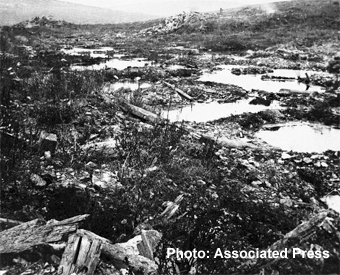
By May 1917, nearly three years of war had reduced the verdant fields of Flanders to a morass filled with shell holes. Three stories in The Luton News revealed that the shell holes could be a blessing for some and a death-trap for others.
In the case of Pte Sydney Allen, of the Essex Regiment, shell holes proved life-savers. In a letter to his wife Florence at 34 John Street, Luton, he told a remarkable story of how under machine gun fire and with a broken leg, he spent three days and nights without food or water crawling from shell hole to shell hole back to the safety of the British lines. But he did eventually have an operation in a Birmingham hospital and lived to tell his traumatic tale.
For Pte John William Cooper, of the Welsh Regiment, a shell hole meant a tragic end. Violet Jane Cooper at 77 Dallow Road, Luton, was to learn in a letter from a Church of England chaplain that her brother had fallen into a deep water-filled shell hole and drowned. Sadly, he had been unable to pull himself out, and by the time comrades fighting around him became aware of his plight he had lost his life.
L-Cpl Davis, of the Machine Gun Corps, hoped a shell hole would provide a sanctuary for wounded comrade Sgt Cyril Meakins. With another comrade and under heavy fire, L-Cpl Davis dragged Sgt Meakins into the shell hole, bandaged him up and stayed with him in the hope that help would arrive. It never did. The two helpers were reluctantly forced to return to British lines, the second man being killed in the process. That night L-Cpl Davis and another sergeant went out to search for Cyril Meakins, but he was never found - perhaps victim of another shell that landed where he lay.
Just three of the harrowing stories from a war it was hoped would end all wars.