

Digest of stories from the Beds & Herts Saturday Telegraph: December 16th, 1916.
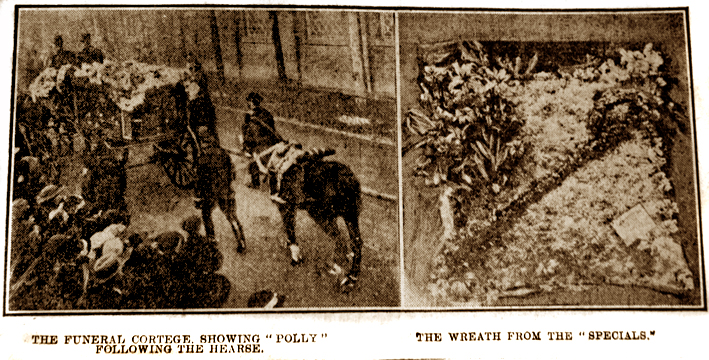
This afternoon, amidst a widespread demonstration of mourning and sympathy, the funeral took place of the late Chief Constable (Mr David Teale). The scenes were most impressive.
The members of the Corporation, the magistrates and others met at the Town Hall, and meanwhile the police force formed up at the Court House.
The regular force marched to the Town Hall, where they led the procession to the house in Dunstable Place, where they left the Mayor and public men to follow the mourners while they themselves went on into Stuart Street to head the procession.
The police, firemen and other units slowly marched along Stuart Street and up Rothesay Road to the General Cemetery. Following came the hearse covered with floral tributes, with the police bearers on either side. On the coffin were placed the late Chief Constable's uniform, hat, belt and sword.
Perhaps the most pathetic figure in the procession was Polly, the late Chief's equine friend, forwhich he had such a great affection. She was led by her groom, Pc Head. Her harness was interlaced with white ribbon, and in the stirrups were the reversed riding boots of the late Chief.
At the cemetery gates the police formed up in a line at either side of the road, and the cortege and public representatives passed through to the chapel. Here again was a large assembly of the public.
In the chapel a simple service was conducted by the Rev E. Lightwood Smith and the Rev A. Wooliscroft, the ministers of Waller Street Wesleyan Church, of which the Chief was a member. The coffin was afterwards borne to the grave,the procession following, and the police formed a cordon round the newly-built brick grave, which was lined with evergreens. The relatives and public representatives stood in the centre while the committal was read.
The police and other units afterwards marched to the Court House and dispersed.
-
In its own tribute to Mr Teale, the Telegraph recalled one stormy period at the declaration of the poll at the General Election on Friday, July 26th, 1895, when Colonel Duke, the unionist candidate, was beaten by Mr T. G. Ashton by 186 votes. So threatening and serious did ensuing disorder become the Alderman Hucklesby, the Deputy Mayor, deemed it prudent to read the Riot Act. Under the command of the Chief Constable, a detachment of London police, sworn in as special constables for the occasion, supported by their Luton comrades sprang to the assualt and the crowd disappeared as if by magic!
-
In the chilly and cheerless unattractive interior of the Corn Exchange last evening some 75 citizens, who for various good and sufficient reasons have been excused the sterner and more dangerous service in the ranks of the King's Army abroad, heartily took upon themselves the responsibilities of home service, as defined in their repetition of the undertaking to serve and of the Volunteers' oath of allegiance read out to them.
-
Forty years ago this week the incorporation of the borough of Luton was celebrated by a banquet at which most of the notabilities of the county were present. A toast was proposed by the Mayor of Luton, Mr W. Bigg.
-
The Artillery Camp at Biscot is the home of versatility. A Military band, a pierrot troupe and an orchestra are now followed by a male voice choir, formed three weeks ago. On Thursday evening the choir made its debut in the Princess Victoria Hut, under the chairmanship of Col C. H. Alexander (Commandant). The concert proved so successful that others are assured. The public may share the privileges of hearing the men when more concerts are given on Sunday evenings.
-
Second Lieut W. G. Oakley, son of Councillor A. A. Oakley, has now gone to the Front after emulating the example of his elder brother, Lieut R. E. "Ted" Oakley, in securing the highest possible marks on the general course and 52 out of a possible 54 in "observations".
-
Luton Town FC's London Combination match at Crystal Palace today was postponed because of fog.