


- Contemporary 1917 photograph of the holed Tyndareus published in the Press.
Lutonians will be interested to learn the experiences of their townspeople who were on the ill-fated transport Tyndareus which struck a mine off the coast of Africa a few weeks ago.
One of them is Cpl Stephen Toyer, Middlesex Regiment, whose home address is 15 Tavistock Street, Luton. He is an old Chapel Street schoolboy, and before joining the Bedfordshire Regiment worked under manager Mr Archibald Cooper at the public baths. He was formerly a member of the St John Ambulance Corps.
He spent a considerable time in France, but received a wound in the eye which necessitated his return to England. After some time in Lord Derby's War Hospital at Warrington, Lancashire, he was transferred to the Middlesex Regiment, and was with them when they covered themselves with undying glory by their heroic behaviour when the troopship was thought to be sinking. The following story is sent by Cpl Toyer to his mother [published in The Luton News, April 19th, 1917]:
"My dear mother, just a few lines to let you know I am quite all right, although you no doubt know what happened to our ship on the night of February 6th. Thank God I have got through with my life! That is all, as I have not anything at present - lost everything, kit and money etc. I have only got a cap, shirt and trousers.
"We got on board the hospital ship Oxfordshire after a struggle, and I am pleased to say we all got on all right. Yesterday we had a reception at the place where we are, and are being looked after very well. It was a godsend the Lord gave us a moonlight night, or we should not have got off so easy as we did, for I got drenched with water, caused by the crash."
In a letter written two days before the catastrophe, Cpl Toyer says: "We are getting a jolly hot time of it, for we passed the Equator earlier this week. We wear only helmets, knicks and vests, and all of us have blistered legs and arms.
"The other day we had a nice thunderstorm, and you know what that it like. It was a treat! We see plenty of sharks and flying fish."
In another letter dated March 5th he says: "We arrived at ----- yesterday morning and are getting on fine - I have never been better. When we marched through the town with our band and another from the town the people made a fuss of us. We were lined up in the big park, and the Mayor spoke to us and welcomed us."
[Cpl Toyer, who was later listed as Acting Sergeant 49386, 25th Middlesex Regiment, was transferred to another ship to make an onward journey to Hong Kong.]
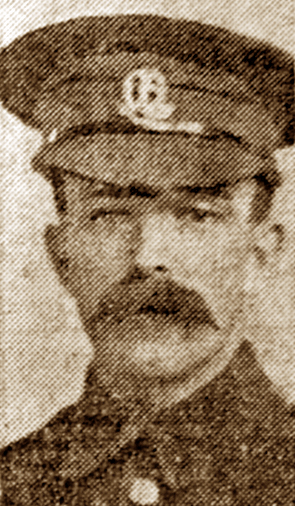 Another Lutonian on The Tyndareus was Pte Frederick Gilbert (pictured right), who lives at 42 Albert Road, Luton. The news was conveyed to his mother in the following letter [published in The Luton News, April 19th, 1917]:
"I suppose you have heard about us having an accident to our ship. We reached Cape Town on February 5th, and after a march through the town started again for the next port. We had been on the water 12 hours and three-quarters when there was a bang near the fo'castle.
"Two ships came to our assistance and we were all saved. How near to death we must have been! Lucky the sea was calm to what it is generally. We were 108 miles from Cape Town.
"After the accident we were on the ship till next night, and then we were put in the train for this town (Wynberg). I thank God that we have been saved from a watery grave.
"The people here are very good to us. They gave us a concert, and the Town Hall is open to us. We get black grapes, for which you wound have to pay 1s 6d a pound, for 1½d a pound. We each has a bag of tobacco and a handkerchief given to us, for which they subscribed in the town."
In a later letter Pte Gilbert says that he had a very enjoyable time at Wynberg, and that he was on his way to his destination.
Pte Gilbert, who is 37 years of age, joined the Middlesex Regiment in October 1916, prior to which he worked at Messrs Hubbard's dye works, Regent Street, Luton.
A third Lutonian on the Tyndareus, Pte Victor Whitcher, Middlesex Regiment, had given his story in this letter to employer Mr H. W. Spratley, a hairdresser at 6 Wellington Street, Luton, which was published in The Beds & Herts Saturday Telegraph on April 7th.
Two other Lutonians are known to have been on board the ship - L-Cpl Cyril Dines (Middlesex Regiment), younger son of Mr and Mrs Arthur Dines, of 70 Crawley Road, and L-Cpl William Thomas Climer (Middlesex Regiment), son of Mrs Sarah Ann Climer and the late Mr Jeremiah Climer, of 30 New Street.
In a letter home that was published in The Luton News (May 3rd, 1917) L-Cpl Dines wrote from Wynberg: "It is an ideal camp - plenty of water, shower baths and baths, and several soldiers' institutes nearby where refreshments and tobacco can be obtained very cheaply. The people of Wynberg are very good to us. Last Friday they gave use a concert and refreshments in the Town Hall, and have opened it as a reading and waiting room, and give tea and refreshments free."
In another letter he wrote: "We have been practising for the guard of honour. When the day came, at 1.30 we left Wynberg for Cape Town and lined the street up to the Parliament. At 3 o'clock the procession came by, consisting of a detachment of cavalry and a carriage containing General Smuts and other prominent personages. It took about a quarter of an hour to open Parliament, and the procession came back again. Then we marched back to the station."
L-Cpl Climer was in Hong Kong when he wrote to his mother [published in The Luton News, September 13th, 1917]. Of his experiences on the Tyndareus he wrote: "We left Cape Town on February 6th with a battalion of Middlesex aboard the Tyndareus on her maiden voyage. All went well until 6.50pm when a fearful explosion made the vessel tremble violently.
"I put on my lifebelt and ran to my boat station. Everyone seemed excited, but this soon passed, and we began to ask the crew if they thought she would go down. They did not answer, but I could see them getting ready to lower the boats.
"By this time she [the Tyndareus] was settling down...The weird blowing of the siren was sending forth its appeal for help. It was about half an hour before the first boat got away. I stood on the gun platform just over the screw and watched it go by. It was so full up that there was little room to get a good stroke with the oars.
"We were told the ship was good for a long time, as they had got the water-tight doors down. Everything depended on a calm sea, but our luck was out again as the wind was getting up and the sea was following suit, which made it difficult to fill the boats.
"I heard a cheer, and looking over the side, saw the first boat from our deck just leaving. I began to weigh the time up and wonder when my turn would come, as there were three more boats to get away before the one I was to go in.
"I noticed a large steamer making for us. It afterwards turned out to be the Oxfordshire, a hospital ship. Just then a shout went up and I saw a man in the water, and the boat hanging on one rope, This was lowered and the boat drifted after the man. My attention was then drawn to another ship.
"I had a walk down the deck, and found that the best part of he men had gone. I had a talk to the man in charge of the engine-room, and he told me the ship would float for hours providing the sea did not get too rough, so I ran down to my quarters and took some belongings. I got back just in time to see them launching my boat. It drifted round to the rudder, the rope broke and the boat drifted away. We had to wait until they sent one back to us."
L-Cpl Climer added that he had to go down a rope ladder, the sea was rough, and the boat was rising and falling about 12 feet. He gave a jump and landed in about six inches of water at the bottom of the boat. He got a seat, and the packed boat was kept to its course only with difficulty owing to the strong current and the swell.
Some of the boats drifted about till the early hours. He managed to scramble up the ladder to the Oxfordshire, and was told by a wounded soldier that they were just starting a concert when they got the wireless message.
They were taken back to Cape Town the following day - a sorry-looking crew, but they were cheered all through the town.
[The Tyndareus was able to be towed into port for repairs and was used as a troop carrier in World War Two before being scrapped in 1960. All 1,030 soldiers and crew on board on February 6th, 1917, were rescued.]