

[From The Luton News: Thursday, November 15th, 1917]
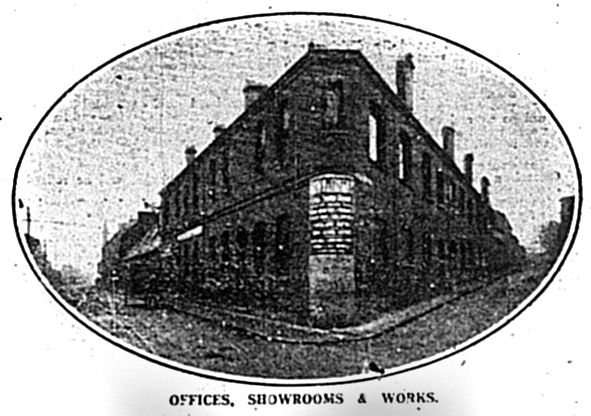
- The Brown & Green premises in Windsor Street/South Road c1912.
It is many a long day since Luton saw such a fire as on Tuesday night [November 13th]. Within a few minutes of an outbreak in the fitting shop of the foundry of Messrs Brown & Green, ironfounders, in Windsor Street and South Road, those thoroughfares were the scene of a roaring furnace.
The fire spread with such rapidity that it had reached alarming proportions before a number of the employees had realised its serious import. Mr George was particularly in evidence splendidly directing them to the various safe exits of which, fortunately, there are a considerable number.
A youth named Frederick Hollis was badly cut about the wrist and arms and had to be taken to the Bute Hospital, and a man was slightly cut on the hand.
The Fire Brigade received the call almost on the stroke of 6.30, and were running out lengths of hose at the scene by 6.35. Chief Officer Andrew was in charge, and the motor was got to work in Windsor Street, and hydrants from the surrounding streets.
The building is a two- and three-storey erection extending about 250ft along Windsor Street and South Road, and the fire broke out on the first floor. The exact cause is not known, but it stated that a cask of oil caught fire, and in a building of this description there is everything to feed and little to retard a fire.
The offices and fitting room were practically beyond salvation, although curious features presented themselves yesterday morning, for the office clock was ticking away right merrily, and rows of files and papers of great importance were untouched except by water or occasional scorching.
The Brigade concentrated on cutting off the fire from the engineering shops and, after strenuous and hazardous labour, succeeded. A feature calling for comment was the daring of the Brigade, for at one period not a fireman was to be seen outside the building. As the flames were driven back so the firemen advanced, and all were playing on the flames from positions within.
The police, under Insp Hagley, with the specials under Chief Special Constable Marks, admirably handled a great crowd and so facilitated the work of the firemen. Chief Constable Griffin was an interested and observant spectator.
A Luton News reporter early on the scene says when the Brigade arrived the scene was appalling in its magnificence. For a distance of 20 yards it seemed as though only a frail barrier of bricks and mortar stemmed a huge torrent of fire, and the walls bulged and quivered with the impact.
Huge volumes of flame flung themselves at the walls from within, in a rapid succession of brazen waves. Through windows, doors and crevices they poured in jets, while great tongues of flame fought through the columns of black and white smoke, tearing away the roof. The heat was terrific and penetrated far down the street, only a few daring souls coming within the zone in a desire to help.
There was a great cheer when through the darkness sprang two great lights, bearing down upon the scene like a monster intent upon giving battle. The brass-helmeted men had the engine in position, hoses run out and facilities made for the combat with remarkable agility.
Within a few seconds, so well did Chief Officer Andrew grasp the situation, they were at work upon the building. The eagerness of the crowd was overcome by the police, who arrived in considerable numbers, and, with this hindrance removed, the firemen were able to concentrate upon their work. Snake-like lengths of hose stretched along three streets, and the whole battle began in real earnest.
The whole town was illuminated, and glass and slates crashed on to the pavement or into the crucible. In and out of the building the gallant firemen sped, and soon the powerful counter-attack of water began to hiss and bark upon the furnace. Silvery spears of water struck hard at the heart of the red flames, and showers of red and white spray glittered in the dazzling brightness.
At first the effect of the water seemed to intensify rather than to diminish the volume of flame. Great frills of steam wove in and out of the black smoke or curled round the spouting flames, and made an awesome fantasy for the spectators. Here and there one discerned the figure of a fireman silhouetted for a moment against a background of flame or yellow smoke, and the burnished helmets gave them a picturesque, as well as being protective, beauty.
A peculiar effect was a long wave of grey smoke which edged the eaves of the building from one end to the other, and above that the revolving and dissolving fleecy billows. Large slates and spars of timber were poised on the edge of the building and dropped inwards or outwards intermittently.
One fireman was unconscious of a narrow escape. As he hurried along the street a huge spar seemed to balance on the edge of the roof and then topple outwards and strike the pavement with a vicious thud a few feet only from the scurrying figure of the fireman.
On many occasions were the helmets of the men struck with slates and glass, and there were many narrow escapes inside the building. Fountains of sparks rose and fell, being scattered far over the tops of the adjacent cottages, as a shaft of water stabbed violently at a target of blazing wood, and the telephone wires danced like silver threads in the radiance.
Like a great question mark hanging head downwards was the hook of a crane in one of the large spaces over the gateway in Windsor Street, and within one could see the red-hot shafts of machinery, the fire-scarred brackets and beams, and with clank and thud parts of machinery melted and fell.
It was a scene such as few in Luton have witnessed so close before. The little cottages opposite were more brightly illuminated than for many a long day. Anxious faces peered out of doors and windows, heedless of the showers of spray, and many hearts returned fervent gratitude to the fiemen as the flames began to dwindle and give place to thicker clouds of smoke.
Nearly an hour had passed before it appeared that the fiend had been subdued appreciably, for as the sullen plumes of smoke appeared at one end the flames lashed out furiously at another. The gateway and the crane floor above appeared at one time to be a wall of unconquerable fire, and the twisted iron supports and bracings looked like the ribs of some great skeleton.
With terrible persistency the flames broke out here and there, licking dry the drenched walls and roofs, but as the firemen ventured into the building where the heat had been most intense it was realised that they had mastered the situation, and an exultant cheer rose from the crowd of awed sightseers when a ladder rose high above the dismantled walls, and firemen began to play from inside and outside of the building.
The half-hour that followed saw the fire brought into subjection almost as speedily as it had spread. Save for smouldering logs and beams the fire was out, and the little bursts of flame here and there were promptly extinguished, and the building assumed a dark and ruinous aspect before eight o'clock. It looked like a dismantled kiln, or a great old-fashioned hearse, with scraggy, weather-beaten plumes shaking and quivering above it in odd and fearsome disorder.
The streets were flushed with water and the gutters were fast-running streams, for many thousands of gallons had been required to quench the flames. The crowd slowly dispersed, but it was not until 10.30, after four hours hard work, that the motor engine returned to the station.
Six firemen were left in charge, and throughout the night they were engaged in dousing smouldering embers which threatened at various points to resume activity. Not until 8.30 the next morning was it deemed advisable for the firemen to leave.
The completeness of the disaster was revealed with the daylight. The charred timbers, the distorted and mangled machinery, much of it quite new and only recently finished, presented a dismal appearance, yet at the side the machines were busy as usual, and work was proceeding uninterruptedly in the engineering shops.
The managing director of the firm is Mr T. D. Galer. Mr H. George is a director, Mr J. Hearn is works manager, and Mr R. Lester the secretary.
A Luton News representative saw Mr George, who kindly spared a few moments to pilot the Pressman through the ruins, but he could give little information except as to the character of the work upon which 280 employees are engaged in alternate shifts.
Mr George said he desired to express the gratitude of the firm to the splendid work of the Brigade, which was simply marvellous, and could not have been more wisely and expeditiously carried out.
He could not give an estimate of the damage, but did not deny an estimate of £20,000, possibly more, for a considerable quantity of valuable machinery is not merely scrap iron, and the building will require reconstruction. Fortunately, the greater part, possibly the whole, of the damage is covered by insurance.
[Two days later, on November 15th, 1917, fire totally gutted the straw hat factory of Wing, Arnold & Wing in Guildford Street.]