

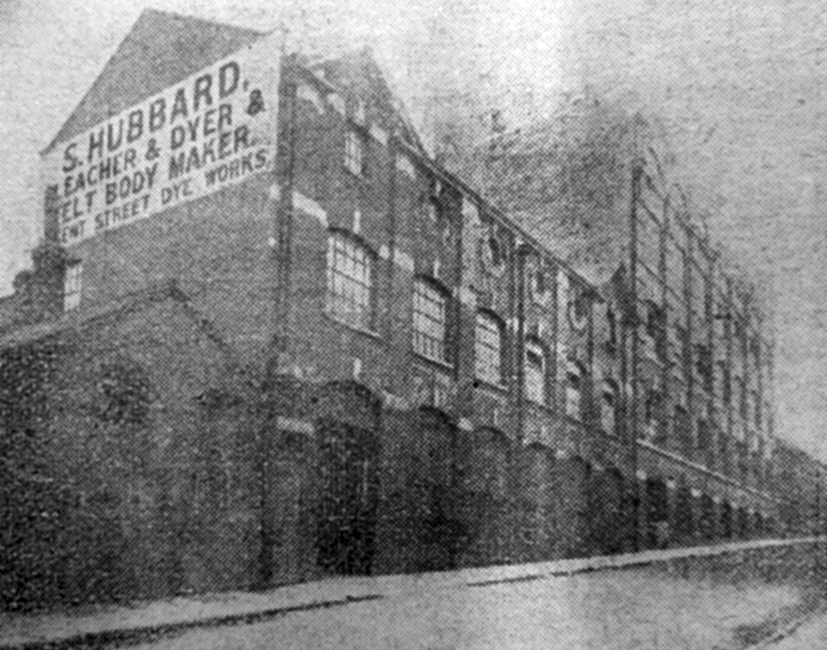
Hubbard Dye Works, Regent Street, Luton
A sad and painful affair occurred at Luton on Saturday afternoon [January 29th, 1916]. It appears that Albert Edgar Giddins, aged 38 years, whose home was at Langley Street, was speaking to the manager of Messrs Hubbard's Dye Works in Regent Street, where he was employed, when he suddenly fell down unconscious.
Medical assistance was sent for at once, but when Dr Lewis arrived he could only pronounce life extinct. In November last the deceased was discharged from the Army on account of heart trouble, and at an in quest which was held at Luton Court House on Monday afternoon, the Deputy County Coroner (Mr G. J. M. Whyley) stated that in view of the circumstances he had ordered a post-mortem examination to be made.
Evidence conc erning this examination was given by Dr Lewis, who said that on Saturday he was called to Messrs Hubbard's works at about 1.45 and saw the deceased lying in the covered yard. He was quite dead, but one or two men were rubbing his limbs.
Witness had since made a post-mortem examination which showed the deceased was a very well developed and very muscular man. The brains were normal and the lungs sound, but there was very bad valvular disease of the heart, which was very much enlarged. But for the appearances associated with cardiac disease, the other organs were normal.
I witness's opinion death was due to heart failure. Since he had been discharged from the Army, witness had attended him for heart trouble.
The next witness was the widow, Gertrude Emily Giddins, who said that since her husband had been discharged from the Army he had been employed at Messrs Hubbard's Dye Works, and during that time for various periods he had been obliged to stay away from work. He seemed much better on Saturday morning, and had a good breakfast before he went to work.
Sidney Herbert Jeffs, of Beech Hill, manager for Messrs Hubbard, stated that deceased was employed as a felt hand. He was a very steady man.
He was speaking to witness about 1.30, having some small complaint to make about his pay, when he suddenly collapsed. Witness broke his fall as best he could, and everything possible was done to bring him round.
Mr Jeffs added that, knowing his heart was somewhat weak, he had put the deceased on very light work.
The jury returned a verdict in accordance with the medical evidence.
[Bedfordshire Advertiser: Friday, February 4th, 1916]