


Stories from The Luton News: Thursday, October 5th, 1916.
Ten airships crossed the East Coast on Sunday night between 9 pm and midnight. One man [William Hawkes, of Stopsley] was killed and one woman injured. Two of the Zeppelins attempted to attack London and one of them - one of the latest type of machine - was brought down. The other was driven off.
The glorious sight of of the pyramid of fire as the burning airship descended to earth in the neighbourhood of Potters Bar was witnessed by many Lutonians and cheered by now a few. A number of people on the Midland footbridge had a remarkably good view of it, and shouted at the top of their voices at the thrilling spectacle.
Others saw it at points as widely divergent as Stuart Street, Park Street, the top of Beech Hill, Round Green and the Downs. Indeed, the whole town was lit up by the remarkable three minutes glare.
-
On Sunday evening, Mrs Scruby, of Hinckley House, Westbourne Road, Luton, received from the War Office the sad intelligence of the death at the Front of her eldest son, Second Lieut William Samuel Scruby (Middlesex Regiment). He fell in action before Thiepval on September 26th. His father, the late Rev W. J. T. Scruby, was the minister of the High Town Primitive Methodist Church from 1899 to 1908.
-
After two years continuous service and participating in the most severe fighting without sustaining the slightest injury, Bombardier Charles William Asbury was killed in action on September 11th. His widow, who has one child, resides with her parents, Mr and Mrs Carter, in Colin Road, Luton.
-
One of a family of eight Luton lads, all serving with the Colours, has made the supreme sacrifice. He was Pte William Brooks, of the Bedfordshire Regiment, afterwards transferred to a machine gun section. He leaves a wife and four children, who live at 108 Castle Street, Luton.
-
L-Cpl Bert Holdstock, of the London Regiment (The Queen's) and youngest of five serving sons of Charles and Annie Holdstock, of 22 South Street, Luton, has been reported killed, according to letters from comrades. [He was killed in action on the Somme on September 16th, 1916].
-
After four months in France, intimation has been received that Pte William Fensome, Suffolk Regiment, was dangerously wounded on September 19th and died the following day at a casualty clearing station. He would have been 29 years of age had he lived until next Saturday, and his birthday present from his wife, Alice, was on its way to him when she received the tragic news at her home at 104 Chapel Street, Luton. The couple have a young child.
-
No further news has been received of Cpl Percy Stimson, 24th Londons, son of Mr and Mrs Stimson, of 45 Alma Street, Luton. [He was later recorded as dying of wounds on September 17th, 1916].
-
Pte William Dovaston, son of Mr R.W. Dovaston of 18 Selbourne Road, Luton, has been killed on the Western Front while serving with the Middlesex Regiment. He was formerly employed at Commercial Cars and was a member of All Saints Church choir.
-
News reached Mr Willet Ball, of 23 Selbourne Road, Luton, yesterday of the death of his youngest brother, Pte George Ball, aged 41, who died from wounds received on September 21st, at a base hospital between Boulogne and Calais. Pte Ball, from Lincoln, was a Grenadier Guardsman.
-
Wounded on July 1st in the first phase of the big advance, Pte George Butterfield, Bedfordshire Regiment, has recovered sufficiently in a military hospital in Wales to be pronounced convalescent. He sustained a bullet wound in the arm and shrapnel wounds in the neck. He is a brother of Mr Alfred Butterfield, of 54 Arthur Street, Luton.
-
Mr F. V. Morris, of Bury Park Road, has heard from his brother, L-Cpl Alf Morris, of the City of London Regiment, stating that he is lying in a Red Cross hospital in France suffering from shrapnel wounds in both thighs. Another brother, Pte F. R. Morris, of the Lincolnshire Regiment, had died of wounds in France on October 5th, 1915.
-
The Military Medal has been gained by L-Cpl Charles H. Bailey, London Regiment (The Queen's), who was an active member of the Chapel Street Wesley Guild. A native of Brighton, he has lived in Luton for some years and his address is 69 Collingdon Street.
-
Another recipient of the Military Medal, Sgt F. G. H. Small, aged 22, of the London Regiment, is the son of Mr G. H. Small, the old Luton cricketer.
-
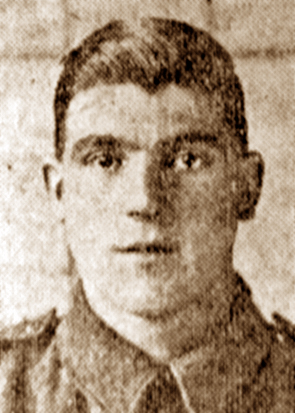 Cpl T. J. Harris (Bedfordshire Regiment), of 23 Jubilee Street, Luton, son of Mr Albert Harris, won the D.C.M. during the terrific fighting in Delville Wood on July 27th. He killed a team of German machine-gunners and single-handedly forced six German officers to surrender, and brought them into the British lines. Although wounded in the left wrist, he returned with comrades and brought back the machine gun. Cpl Harris is pictured, right.
 -
On Wednesday, September 27th, the Medal for Distinguished Conduct in the field, won by L-Cpl H. Titchmarsh, of Stopsley, was presented to him by the Brigade Commander of the 26th Training Reserve Battalion, to which he is attached. The medal was awarded for conspicuous gallantry and devotion to duty on the night of 17th January, 1916, near Fricourt.
-
The 12.42 Midland express to London failed to stop at Luton on Monday, but the mistake was greatly covered up by the Luton officials. The train ran through at top speed, so another express due to pass a few minutes later was stopped for the convenience of the Luton-London passengers.
-
The memorial services at the Parish Church and Luton Hoo Chapel on Sunday afternoon for Second Lieut Alexander Pigott Wernher, Welsh Guards (who fell in action on September 10th) were most impressive. The whole town and district have sincerely sorrowed with the Lady of the Manor in her loss, and Sunday's services were further witness to the depth of feeling. The Rev J. E. Westerman, Vicar of East Hyde, officiated at the service in the Hoo Chapel. The Mayor, Alderman J. H. Staddon, and councillors and officials were among the large attendance at the Parish Church, where the service was led by the Vicar, the Rev A.E. Chapman.
-
The Servite Catholic Church, Fulham, was the scene of the wedding of Lieut William H. C. Baker, of the London R. F. A., Biscot Camp, and Miss Alice Smith, of Chelsea. Among the presents was a timepiece given by members of the Officers' Mess at Biscot Camp.