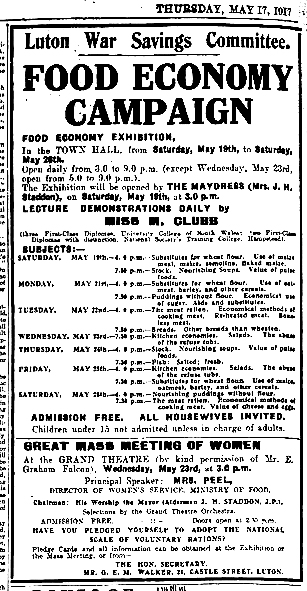
Digest of stories from The Luton News: Thursday, May 17th, 1917.
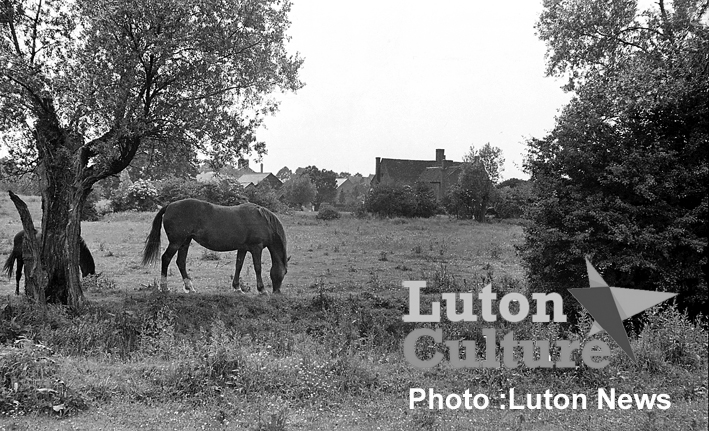
- Limbury looking idyllic in 1948, 30 years after a diphtheria outbreak.
Another grave outbreak of diphtheria in the parish of Limbury was the subject of serious consideration by the Luton Rural District Council on Monday. Dr Rollings, the Medical Officer, said there was a possibility that the disease might be spread by a contact at school.
There might be some infected books, he said. A previous outbreak had been traced to a 'carrier' case. It was quite possible for a child suffering from the disease to sneeze or cough on to a school book. Then it would be closed, the two pages would stick, the next child would open them, and that would be sufficient to cause another outbreak.
The Medical Officer and Director of Education both agreed that the whole of the articles, including the books, should be destroyed and that the school should be closed for about a week to be thoroughly disinfected. They also agreed the swabs should be taken of the throats of the children, numbering 125 to 130. If they had infection there they would probably get to the bottom of it.
The Clerk (Mr William Austin) explained how on a previous occasion the disease was spread by books. Articles at a school were destroyed, but they stopped the outbreak.
After hearing that there were 28 cases of diphtheria, plus six or seven fresh cases, the Council agreed that the destruction of articles should be proceeded with, and swabs taken from the children.
-
Events surrounding a strike by engineers at local munition factories were included in a round-up of the dispute. The engineers, in common with others around the country, had walked out the previous Friday. A series of meetings had been held without reaching a resolution, although potential confrontation between soldiers and strikers had been avoided. Amid letters from the public deploring the strike and an unofficial statement from an unnamed trade union official explaining their reason for holding it, The Luton News said it was possible work would resume on Friday following a conference on Thursday afternoon in London.
-
One firm that avoided being embroiled in the strike was aeroplane manufacturers Hewlett & Blondeau at Leagrave. There, directors expressed their appreciation of the loyalty of several hundred employees by inviting them to tea on Sunday afternoon. Mrs Hilda Hewlett and Mr Gustav Blondeau were among those who attended the event. Mrs Hewlett said: "On Friday last, at four o'clock, Mr Blondeau, Mr Roberts (works manager) and myself thought that we must fail the airmen and that our output must be less because of this strike. The call came to you to help, man and woman, and you have answered it like soldiers. You have taken your trenches, your prisoners by the work your have done. This lovely Sunday has been a day of sacrifice shared with your soldiers.

-
The new Chief Constable (Mr Charles Griffiths) inspected the members of the special constabulary when they assembled for drill on Sunday afternoon. About 50 paraded, and they were put through various exercises by the instructor (Sgt Wells). Mr Griffin expressed his satisfaction at what he had seen , complimenting the men on their drill. [Mr Griffin is pictured above with the specials in a 1917 picture.]
-
Mrs Fanny Lake, of 100 Ash Road, Luton, has received information that her husband, Pte Harold Alfred Lake, of the Bedfordshire Regiment is missing and believed to be a prisoner. She hoped his friends at the Front would see her appeal for information about him. [Pte Lake is recorded as killed in action on April 13th during the Battle of Arras.]
-
Reports about other men to be added to the Roll of Honour included: Second Lieut Leslie Wyndham Mansell (Durham Light Infantry); Pte William Burkitt (Royal Army Medical Corps), 12 Henry Street, Luton; Pte George Hull (Beds Regiment), Upper Sundon; Pte Frederick Perry (Leicestershire Regiment), 13 Park Place, Luton; P-o-W Gunner William Childs (Royal Garrison Artillery), 32 Dorset Street, Luton; L-Cpl George Kidman (Beds Regiment), 16 Ashton Road, Luton; Sapper Harry Jeakings (Royal Engineers), 8 Highbury Road, Luton; Pte William Souster (East Surrey Regiment), 446 Hitchin Road, Luton; Pte Frederick William Pestell (Beds Regiment), 98 Cobden Street, Luton; Sgt William Day (Beds Regiment), 196 High Town Road, Luton.
-
The wife of Pte G. Butterfield (Beds Regiment) has been notified that he was wounded in the finger and jaw by a shotgun and is now in Bristol Hospital. He was previously wounded during the Somme advance. Prior to enlistment he was employed by the Diamond Foundry and resided with his wife at 152 Park Street.
-
Mrs Moody, of 81 Ridgway Road, Luton, has been notified of her husband's wounds in action. Pte F. Moody (Beds Regiment) is 33 and was a stretcher bearer carrying a wounded man to safety. A shell burst two yards in front of him, killing oner stretcher bearer and wounding Pte Moody in the left arm. On his way to the dressing station he received a bullet on his right hand. Two more bullets went into his tunic and he was also buried with earth on the same day. Prior to enlisting he was a plait machinist for Mr W. Day, of High Town Road.
-
The Misses Frisby, under whose admirable supervision the work of the Plait Hall YMCA was carried on during the past winter, have gone away for a well-earned rest. They will return before the end of this month to resume charge of the YMCA tent just erected at Stockwood, as the 17th Training Reserve Battalion are under canvas there now.
-
In order to test the efficiency of the arrangements for coping with fire at Biscot, a test call was given on Monday evening. The alarm was sounded, and a telephone message was then sent to the Luton Fire Station. So prompt was the response that the motor engine was on the spot and the water turned on within 5½ minutes of the alarm being given. The military brigade also showed praiseworthy alacrity in turning out, just managing to beat the civilians by a short head.
-
Mrs Burditt, one of the honorary secretaries of the Luton and District Branch of the National Union of Women's Suffrage Societies, has received a letter from Mr Cecil Harmsworth MP in which he said he would support with much pleasure such measure of Woman Franchise as the Government was prepared to accept. He added that he had had a better opportunity than most of observing the splendid national service rendered by women during the war years "and such lingering doubts as I entertained, especially during the period when militant tactics were allowed to discredit the movement have been dissipated by the patriotic activities of the great armies of women who are working for the successful prosecution of the war".
-
The Luton Red Cross Silver Prize Band, under the conductorship of Mr W. A. Hollis, gave a very enjoyable programme at Wardown Park on Sunday afternoon, when the glorious weather attracted many people to the park. The collection, which was on behalf of the Comforts Fund for members of the band who have joined the colours, amounted to £6 8s 9½d.
-
A cookery demonstration at the Town Hall on Saturday will be opened by the Mayoress (Mrs J. H. Staddon), and the Mayor asks us to state that he hoped the public, especially ladies, will turn up in crowds for the opening ceremony, particulars of which appear in the advertisement below.