

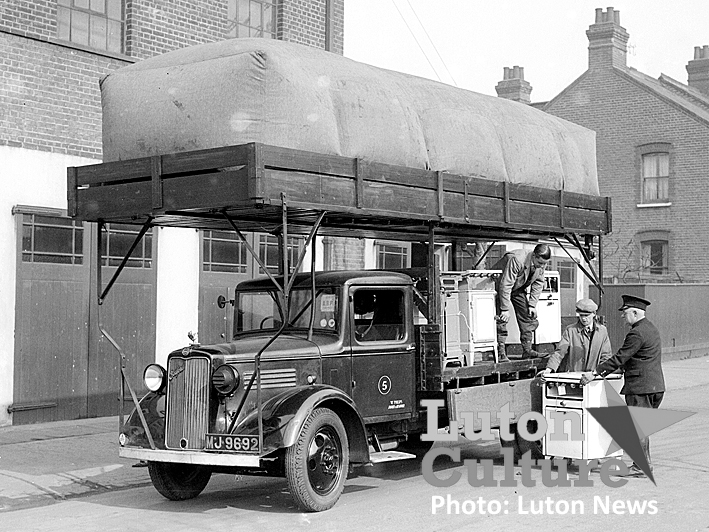
- WW1 gas power innovation, here reintroduced in Luton during WW2 for gas cooker deliveries.
As war dragged on, essential supplies, including food, were becoming scarcer and dearer. The needs of the military and the menace to shipping posed by enemy submarines were having an impact. By the autumn of 1917, petrol supplies were also beginning to give concern - so was there an alternative fuel for motor vehicles? One Luton firm thought there was, as a writer for The Luton News explained in the following article:
As the days go by the petrol restrictions imposed by the Government become more and more drastic, and municipal authorities in many parts of the country have now been notified that in future petrol supplies will not always be forthcoming. Few of the big business firms in Luton, up till a few weeks ago, hardly realised how serious the position really would be and, although the fact was foretold scores of times in the last year or so by many of the leading journals devoted to the motoring world, the news came as a shock to many.
Petrol substitutes were tried, but it was found the combined effect of the restrictions on these and the inferior results obtained, rendered the situation as hopeless as before. It thus became clear that unless a cheap and efficient substitute could be obtained - for this was obviously the only way in which the difficulty could be surmounted - civil industrial transport in Great Britain would be indefinitely suspended.
Many firms are now beginning to turn to coal gas as a fuel instead of petrol, and locally Messrs E. W. Hart & Son Ltd, the well-known bleachers and dyers, are to be congratulated on being the pioneers of this movement in South Bedfordshire. After extensive experiments recently with coal gas, Mr Oscar Hart informs the writer that they have been entirely successful.
Residents in the Windmill Road and Crawley Green Road district have no doubt frequently seen of late a curious-looking vehicle - a car bearing on the top of the van a basketwork carrier on which is reposed, in all its splendour, a light brown (practically khaki) cylindrical 'sausage' looking more like a smaller edition of those Hun frightfulness, the Zeppelins, than anything else.
Now and again the car will be seen on its trial trips through the lanes and byways round Luton, and maybe on one of these jaunts after dark it would strike terror into the heart of a wayside traveller!
It is only during the last nine or ten months that the question has been given very serious consideration, Mr Hart told our representative, but in every experiment it has come out successful beyond the hopes of all.
The pioneers in England were Messrs Andrew Barton Bros, of Beeston, Nottingham, and gradually the movement is spreading over the whole of Great Britain. From the time the Government began to take action and to restrict the supplies of petrol, Mr Hart has had increasing difficulty with regard to his supplies, and has at last been compelled to bring back into use the horses and vans which had practically been superceded by the motor vehicle.
Motor spirit having decreased both in quality and supplies, Mr Hart, like other enterprising men in England, turned to coal gas as a source of motive power. This, at first sight, seems absurd but, as a prominent journal has it, the ridiculous of yesterday has become the indispensable of today. And surprisingly good results have been obtained.
In the first place, Mr Oscar Hart fitted up a basket-work carrier on the top of the van and fastened the 'sausage' on top. By means of a special main which the Gas Company have installed for the purpose,and which has a delivery pipe of two inches diameter, the balloon, which holds 280 cubic feet of gas, may be filled in less than a quarter of an hour.
When fully inflated, the whole indeed looks rather cumbersome - top heavy, as it were - but the balloon is made of a particularly light fabric of canvas lines with rubber and, although rather unwieldy, is certainly not heavy and does not affect the distribution of the load to any appreciable extent.
During the final trips which Mr Hart has taken, the gas has proved itself to be by far a more economical and cleaner fuel than petrol or any substitute. With a full load, the maximum distance which could be traversed by the car in use, on a gallon of petrol, was 18 miles, and this, with petrol at five shillings a gallon, is not by any means cheap.
Mr Hart has proved to his own satisfaction that the same distance can be covered using only 500 cubic feet of gas. Every householder knows that the average price of gas in Luton is about 2s 2d or 2s 4d per 1,000 cubic feet, and it is obvious what an immense saving will be affected.
Mr Hart has also found that the engine runs better and the whole process is cleaner. There is practically no tendency for the cylinders to 'soot' and get clogged with carbon. Petrol and petrol substitutes often create a great deal of trouble in this respect.
A great advantage of the new process is that both gas and petrol may be used. The gas is conducted by a tube straight from the holder to the carburettor and does not interfere with the petrol feed at all, so that if at any time the supply of gas gives out the petrol tap may be turned on and the journey finished on petrol.
Another great advantage will become prominent as the cold weather sets in. All motorists know the difficulty of starting the engine in cold weather, chiefly because the patrol refuses to vaporise. Obviously, if the fuel is in the gaseous state already, this difficulty is altogether overcome.
Some may ask, why not, in view of the unwieldy nature of the gas bag, replace it by a cylinder or cylinders of compressed gas? This would obviously ensure an adequate supply of gas, but on the other hand the cylinders themselves would, unless made of a very light material such as aluminium, add to the load. On a small car that would make a tremendous amount of difference, but it may be mentioned that experiments are being made in connection with the use of cylinders and very satisfactory results are being obtained.
Others may ask: "Is there not a risk in the carriage of so large a quantity of inflammable gas?" Mr Hart, in company with the prominent motoring journals, points out that there is no more danger than there is when petrol is used as fuel. There is, of course, just a risk that an overhanging obstruction, such as the branch of a tree, might cause a leak, but even if the gas did catch, the conflagration would only last a few seconds and probably then do only slight damage to the car since the holder is situated on top, whereas petrol would cause much more serious damage if ignited.
Readers will realise the safety of the new method in the significance of the statement that the Accident and Fire Committees of the Tariff Insurance Companies have decided to ask no increase of rates for motor vehicles using coal gas as compared with those using petrol.
In wishing Mr Hart every success in his venture, it is to be hoped that his example will be followed by other Luton firms who, we may be sure, will be only too ready to do their utmost to save all the petrol possible for the needs of the Army and Navy.
[The Luton News: Thursday, September 20th, 1917]