

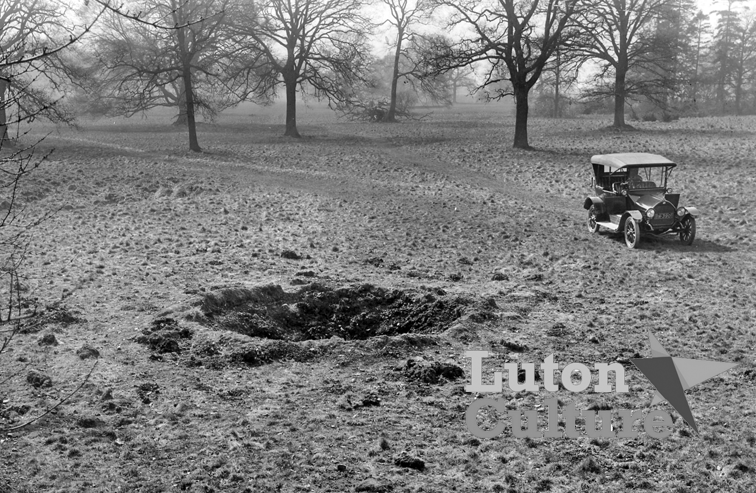
Bomb crater created by an airship on the Luton Hoo Estate in a later raid.
In its Thursday, September 7th edition, The Luton News carried this report of a rural correspondent's experiences of being close to the scene of the September 3rd airship raid:
It was soon after the Sabbath day was ushered in that the first alarm came. I was still in my sitting room when there was a dull thud which shook the house, and within a minute or two there were two further shocks, and then there was a sound resembling the distant roar of an express train immediately overhead.
It quickly passed out of hearing, and a few minutes later I went to bed. It was about an hour later when a couple more thuds woke me, but when I looked out there was nothing to be seen and I returned to bed and was soon fast asleep.
On Sunday I made my way in the trek of the rest of the company to a beautiful park where woodland, cornfields and pasture alternate. Some thousands must have visited the place during the day and done as I - gazed at a hole some six to eight feet deep in a cornfield in which the sheaves remained ungathered.
And this was where the bomb had dropped. It had gone far below the soil and huge lumps of clay, as much as a man could lift, lay in the hole, while the smaller clods lay some distance around.
The hole was about 15 to 18 feet in breadth, and it was a hole and nothing more - yet visitors seemed loath to leave it. They showed no sign of agitation or fear, but discussed what might have been and expressed thanks that the bomb had fallen where it could do so little harm.
Less than 50 yards distant is a small cottage, and one of the windows was broken. That was the only damage. Outside, a goat was browsing in the ditch, and its little shed was even nearer to the scene of the upheaval than the cottage. It takes a good deal to upset the appetite of a goat, and this lady was no exception, and she appeared to be more surprised at the number of visitors than at anything else.
Outside the cottage was the tenant - a sturdy son of the soil whose equanimity was as unruffled as that of the goat. In response to the inquiries made by the visitors who lined the fence to congratulate him on his escape, he grinned cheerily and showed no qualms whatsoever.
His descriptive story was brief, and only when he warmed up to his subject did he add any gesture. He was awakened by the noise of the bomb when it hit mother earth and broke the window. Getting up he was in time to see it [the airship] disappear "over there," and he flourished his stick in a northerly direction. He was discussing the damage when the Zepps returned and passed over. There were two more bangs and that was the last of them.
His life continued on Monday as it had done on Saturday, working on the estate and marvelling only that his house had escaped by a miracle, instead of which, as a matter of fact, it would have been a miracle had it been hit, since it and the next house are pretty nearly a quarter of a mile from any other.
The mansion in the middle of the park contains some priceless treasures, and everybody who knows it will be glad that it escaped the vandalism of the Hun. It is not fortified, although the Wolfe Press Bureau of Berlin will probably claim that all bombs were dropped on fortified places.
The field in which the bomb dropped contains a crop of corn, and the total damage is probably a few sheaves of wheat and five shillings-worth of glass.
There were varying estimates of the number of the flight of airships - some said three, others four, and a few averred there were five. But probably the most truthful are those people who admit it was too dark to ascertain.
Further away from the scene a young lady who left Luton on Saturday to take up a situation in London wrote of her experiences of the raid. She said:
I had not been in London more than six hours when I experienced my first air raid. Before going to bed my sister warned me to have everything ready, as I might have to dress hurriedly in the night because of the Zepps, and sure enough about 1.45 am we heard the first gun boom out.
Everywhere was all excitement, everyone seemed to be dressed and out of doors. Of course we soon joined the throng, and on looking up at the end of the road, there was a Zepp with searchlights splendidly focused on it. Meanwhile shells were bursting all around it from the guns and the noise was terrific - so near that we felt the shells must drop in our road.
Suddenly it disappeared, having taken shelter no doubt from the smoke which I understand thay are able to throw out. Waiting about five minutes to see if it would reappear, we decided to go inside.
Scarcely ten minutes later my brother-in-law, who was watching from the back of the house, called out: "Come quickly, the Zepp is on fire". We rushed to the window and saw the Zepp one mass of flames - it seemed to stand upright, and then sank in the distance.
Never shall I forget the sight, it was wonderful. When people saw the Zepp burning there was so much clapping and hurrahing that one would think peace had been proclaimed.
We have just heard the Zepp fell in the vicinity of Barnet. Yet how near it appeared! One could not realise that it was so far away.
[The 'Zeppelin' was in fact a German Schutte-Lanz airship, SL-11. All 16 crew members lost their lives.]