

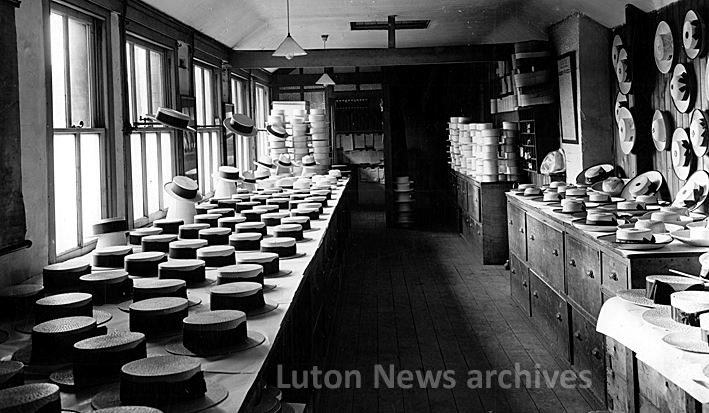
The trade of Luton has been very brisk during the past month, wrote a straw trade expert. In all departments for the bleachers and dyers, and for the manufacturers, there has been great pressure in the velour, felt and covered hat selections, while some makers have also rejoiced in considerable orders for straws.
Altogether, therefore, one can say that the district should not have had a bad autumnal season. In velours the demand has been quite in excess of the possibilities of supply, and makers of these goods have had a fairly harassing time, for supplies of hoods have been in many cases long overdue.
Some other houses took "time by the forelock" and got large stocks in hand very early on in the year. These have been, of course, "in clover" and have been able to secure a splendid portion of this very acceptable trade. Other have not been so fortunate even with early placed orders.
The writer of this report only during last week saw in a warehouse a delivery of velours just come in that were due in the seconds week of May last! Even then, fortunately, they were not too late, for the provincial buyers of millinery goods are still open for large quantities.
For the wool velours, as they are called, the demand also has been large, and some Luton houses have quite surpassed themselves in the excellence of the finish of these articles. These are ordinary wool felt hoods made a little thicker in substance than used to be the case in the past days when wools were heavily proofed. They are subjected to a scarifying process between rapidly revolving wheels, one of which is covered with glass or sandpaper.
This process drags out all the long fibres of the wool and at the same time cuts off the ends in a fairly level manner. The hoods are then subjected to another operation where the wheel is of buff felt, and which polishes the ends of the fibre, giving them a glossy appearance. The result is a very good imitation of the real fur velour.
This process was first adopted in Luton many years ago by Messrs Stuart, Sons & Co (then of Wellington Street), it having been invented shortly before, but since that time the machinery used has undergone some materially improving changes, and the results now are far superior to those then available.
For covered hats one hears the trade has been patchy. Some of the better class houses have had an unusually good time in the higher priced articles such as hatter's plush, or Lyons silk velvert, and some of the houses who cater for lower medium priced goods in velveteen or cheap silk velvets and plushes have done well, while others have been very slack. These remarks apply also to the "straw" section of the trade. Some few have had a really good autumn season on straws, while others have not been able to do much.
Bleachers and dyers, who now generally include in their works the manipulation, or dyeing, or both, of velours and felts have been extremely busy in this class of goods, and have also rejoiced in considerable business in bleached and dyed straw or tagal plaits.
The season, however, is now drawing to a close, and some houses are already branching out in sampling for the spring of 1918. At present the principal items used in samples are pedal tagal and the broader numbers of Lisere. There is not much novelty shown either in shape or manipulation, and the only apparent recommendation of the early samples is their close prices.
Under the present conditions there are no words too strong to condemn anything like a cutting price for any plaits. In the old days there were times when certain plaits seemed useless, and perhaps when it was wiser to clear than to hold, but today, when the embargo on imports is as it is and one does not know with certainty on what to rely for futures, it is quite probable that plaits now under a cloud may, like the old chip fancies of last season, be most valuable properties during the season. One must say, however, that the cutting competition had not been anything like so severe lately as it used to be. Is this the result only of the war or have the admonitions published in this paper had anything to do with it?
As to the embargo on plait imports, there seems to be in some way or other a bit of a mess! China straw plaits can only some in under licence for re-export, in either the grege or bleached and dyed state. No notice is taken if the plait is to be made into hats for export. Now this seems absurd, because the plait going to our overseas competitors will be made into hats there that perhaps Luton might have made!
Rumour has it that the arrangement was made with the Controller by a deputation from Luton which did not include all sections of the manufacturing trade. If that be so, a grave injustice has been rendered to the town and trade by some of their own members, and it is to be hoped that some means will be taken to end this altogether stupid anomaly.
The standard shade of colours has not come out yet, although the dyers have issued a new schedule of prices, which it may be noted, do not err of the side of cutting cheapness. As to merits or demerits of the new inducement offered by the Dyers' Association in the form of an extra 10 per cent obtainable under certain conditions, this article will not venture to enter, except to say that there are probably conditions of prior use of certain goods that would enable the manufacturer to still continue to purchase them, and yet not come under the penalising effect of the dyers' clause.
This matters should be carefully taken up by the Straw Hat Manufacturers' Association. for now is the time when rights must be carefully conserved, and whole trade should look to it that it is in no way exploited by any section. No suggestion is here made that such is the case here, but with strong associations against a divided trade things may be done which would amount to an injustice unless careful precautions are taken.
[The Luton Reporter: Wednesday, October 3rd, 1917]