

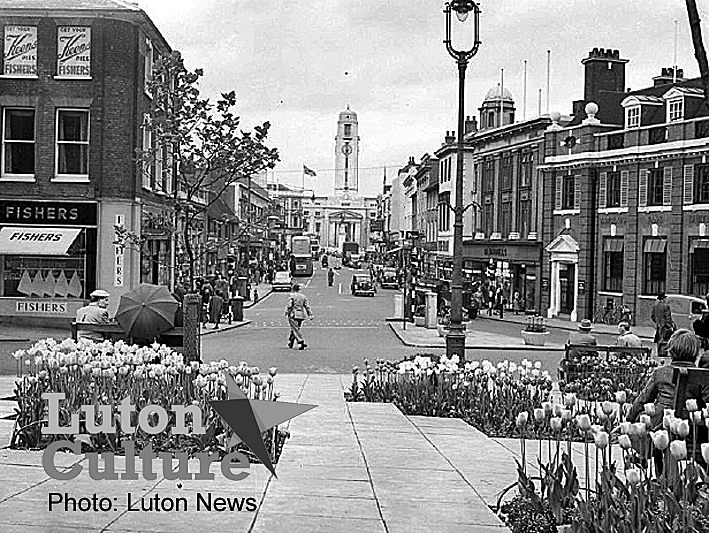
- Barclays Bank (far right) and George Street in 1954.
A new branch of Barclay's Luton Bank was opened on Tuesday, April 10th, 1917. The Luton News heralded it as marking an epoch in the town's commercial history.
The building is of a handsome character, said the newspaper report in the week before the opening. It is artistic in design and handsome in its accommodation and appointments. The banking hall is spacious - 54ft by 50ft -and lofty and easily beats anything among the great Banks of the country for many miles around.
Entering the hall from George Street, the portion reserved for the use of customers runs from front to back, where are situated the manager's interviewing and waiting rooms. Midway down the hall on the left is a massive oak fireplace, and on the right, from front to back, runs the counter, all in panelled oak with mahogany top and providing desks for eight cashiers. The floor space provided for the public is covered with the patent Rust paving, which is now so much in demand in all modern buildings.
Whilst the doors, counter and fittings are of panelled oak and are distinctly pleasing, a striking feature of the fine banking hall is the loftiness of the ceiling, which is arranged in 12 handsome panels with heavy moulded cornices and enrichments. Only two pillars have been introduced in the hall to carry the constructional work overhead.
On the staff side of the counter the flooring is of wood blocks, and the desk accommodation for the large staff is just about double what it was in the building which formerly occupied the site. The heating is by a system of hot water, and the comfort of the staff has not been overlooked in any detail.
It was in June 1915 that the Bank was removed to temporary premises in George Street West, and the demolition of the old building and the shop adjoining occupied by Messrs E. Deacon and Sons was begun.
Under ordinary conditions the new building should have been completed some months ago, but the war has delayed it, and even now Messrs T. and E. Neville have not been able to thoroughly finish all the woodwork. The building, however, is thoroughly dry and in every other respect ready for occupation. Consequently advantage is to be taken of the Easter holidays to 'flit' back again to the old site, and Tuesday morning next will see the doors of the new building opened for business.
Externally the building is of Georgian architecture, red brick being relieved by white stone dressings.
Although the new Bank was designed with a manager's residence over, plans have been somewhat altered in this respect, and the Luton Bank will now be the head office of the Bank. Hitherto, St Albans has been regarded in this respect, but Luton, by reason of its commerce and industry, now takes its proper place as the first office in the area, comprising also St Albans, Watford, Harpenden, Ampthill, Radlett and Mill Hill, with a number of sub-offices.
This being the case, the rooms on the first floor are being utilised for business purposes, and they are all handsomely appointed. The top floor - a very fine suite of rooms also - will acoordingly be used for the accommodation of the caretaker.
The actual ground covered by the new building is much more extensive than the old. The ground floor measures 90ft depth from front to back and, in addition to the manager's office, and the interviewing and waiting rooms, there is a strong room for securities and extensive rack room.
The basement, which is well lighted and beautifully dry, contains two other strong rooms - one for the books of the bank and the other for deeds. There is a handy electric lift from the basement to the banking hall.
The system of lighting is also by electricity, and in the banking hall itself the system is by indirect lighting, the rays of the arc being reflected from the ceiling.
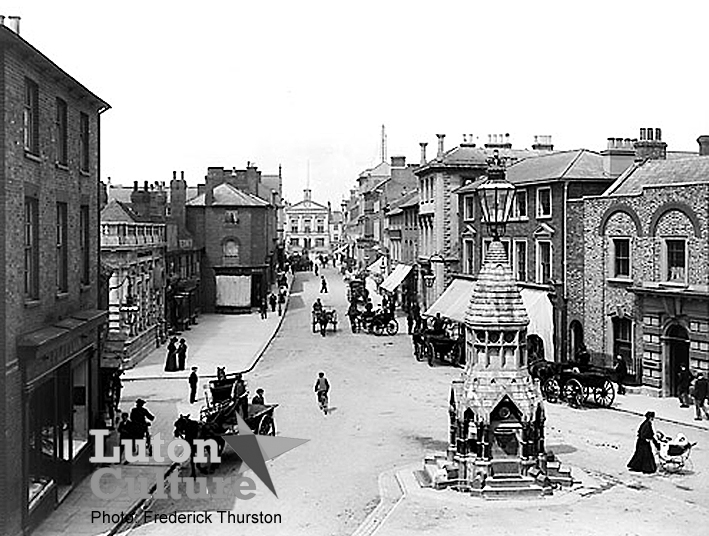
- The previous Barclays Bank (far right) and George Street in July 1900.
[The Luton News: Thursday, April 5th, 1917]