

A crowded and enthusiastic audience of attested married men met in the Castle Street Hall, Luton, on Monday evening [March 20th, 1916] to send a protest and reminder to the Government over its pledge to call up single men first.
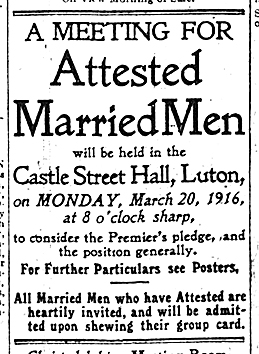 The following resolution was passed: "That this meeting of attested married men desires respectfully to remind the Government of its definite pledge to take single men first; that we are convinced many men who were then single, and not in reserved occupations, have escaped the Military Service Act by leaving their usual employment and entering reserved trades; and that we cannot regard the pledge as being kept until such men who are not actually indispensable have been called out and made to serve.
"We note now that it is the Government's intention to remedy this grievance, but that it has been declared to be impossible to do this in time to prevent calling upon the married groups. We therefore consider that an entirely new situation has arisen, to meet which the only proper course is to conscript all men of military age, so that the loyal attested men should not be called upon to bear the whole burden, while the unattested men escape.
"We therefore ask that all notices calling up groups of married men be withdrawn until (a) all single men engaged since August 15th last in reserved occupations, and not actually indispensable, and those sheltering themselves under the plea of conscientious objection, are called up for service, or (b) until a revision of the Military Service Act so as to include all men of military age.
"We therefore request that adequate provision to meet domestic and business obligations of married men when called up, be made."
The meeting was held under the chairmanship of Luton auctioneer Mr Hugh Cumberland. He admitted that during the operation of the Derby Scheme he had unhesitatingly advised married men to join. To all those men he apologised as he would not have given that advice had he not believed that they would have had fair play meted out to them.
The married men had not asked for a pledge, but Lord Derby, fearing that his scheme would not be successful, had approached the Prime Minister, who on November 2nd said that the obligation on the married men to serve should not be enforced until they could obtain the unmarried.
[The Luton News: Thursday, March 23rd, 1916]